English
 简体中文
简体中文 Français
 日本語
日本語 한국어
한국어 Português
 Русский
 Español




Tel Number
181-3719-5600
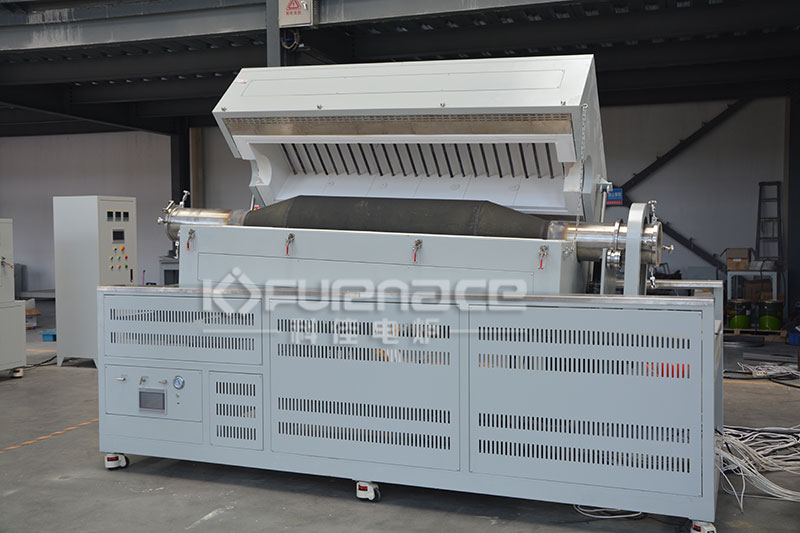
Rotating tube furnaces can be used for sintering battery materials, especially in scenarios where powder materials are processed, uniform heating is required, or specific atmosphere control is necessary. Let’s take a closer look!

Commonly used vacuum powder rotary tube furnace (click on the picture to view product details)
1. Technical adaptability: The rotary tube furnace meets the core requirements for sintering battery materials
Uniform heating and temperature control
The rotary tube furnace rotates the furnace tube to make the material roll inside the furnace, combined with the hot air circulation system, to achieve uniform heating of the material. For example, in the sintering of positive electrode materials for lithium batteries (such as LiCoO ₂), uniform heating can avoid crystal defects caused by local overheating and improve material capacity retention. Part of the equipment adopts a polycrystalline mullite fiber vacuum adsorption furnace, with a temperature field uniformity of ± 5 ℃, meeting the high-precision temperature control requirements.
Controllable atmosphere environment
The device supports the introduction of inert gases (such as argon), reducing gases (such as hydrogen), and mixed gases, and the gas ratio is precisely adjusted through a mass flow controller. In the sintering of negative electrode materials for sodium ion batteries, the mixed atmosphere of hydrogen and nitrogen can simultaneously achieve metal reduction and nitridation, simplifying the process flow. In addition, the vacuum rotary tube furnace can eliminate impurities such as water vapor, avoiding the precipitation of corrosive gases during the sintering process of non carbon negative electrode materials (such as silicon-based materials).
Continuous production and efficient heat transfer
The rotary tube furnace adopts a continuous feeding design, where materials move rapidly within the furnace tubes, resulting in high heat exchange efficiency. For example, a 1200 ℃ powder sintering tubular rotary furnace can achieve rapid sintering of lithium battery materials, activated carbon materials, etc., with higher single batch processing capacity, suitable for pilot and large-scale production.
2. Application case: Practice of rotary tube furnace in the field of battery materials
Sintering of lithium battery materials
Positive electrode material: The rotary tube furnace is used for sintering materials such as LiFePO ₄ and NCM (nickel cobalt manganese). By effectively controlling the sintering temperature (700-900 ℃) and atmosphere (oxygen or air), the crystal structure of the material can be optimized and the cycling stability can be improved.
Negative electrode material: Silicon based negative electrode materials are prone to agglomeration during the sintering process. The rotating tube furnace reduces agglomeration by rolling the material, and with the help of a hydrogen reducing atmosphere, high-capacity, low expansion silicon carbon composite negative electrodes can be prepared.
Sintering of sodium ion battery materials
The sintering of positive electrode materials for sodium ion batteries (such as Na ∝ V ₂ (PO ₄) ∝) needs to be carried out under an inert atmosphere. The rotating tube furnace is protected by nitrogen to prevent material oxidation, and the rotating design ensures uniform diffusion of sodium ions to improve material conductivity.
Synthesis of Solid Electrolyte Materials
The synthesis of sulfide solid electrolytes (such as Li ∝ PS ₄) needs to be carried out under a dry inert atmosphere. The rotary tube furnace can integrate a drying gas system and achieve batch preparation of high-purity electrolytes through precise temperature control (500-600 ℃) and atmosphere control.
3. Equipment advantage: Upgraded rotary tube furnace compared to traditional furnace types
Reduce material handling and manual intervention: The rotary tube furnace reduces the number of manual loading and unloading times and lowers pollution risks through continuous feeding and automatic discharge design. For example, in the sintering of lithium battery materials, automated production lines can reduce many manual operations and improve production efficiency.
Flexible adaptation to multiple process requirements: The equipment supports independent control of multiple temperature zones, and the temperature settings of each zone do not interfere with each other, which can simultaneously meet the multi-stage process requirements of material preheating, sintering, annealing, etc. For example, a 1200 ℃ three temperature zone vertical vacuum atmosphere tube furnace can achieve gradient sintering of lithium battery materials and optimize material properties.
Durability and safety: The furnace body and key components are made of high-quality materials (such as high resistance alloy wire 0Cr27Al7Mo2), which are corrosion-resistant, high-temperature resistant, and have a long service life. At the same time, the equipment is equipped with multiple safety functions such as over temperature protection, leakage protection, and automatic power-off when the furnace is turned on, ensuring the safety of the experiment.Click to learn more Customized Tube Furnaces! Or click on online customer service to learn more about product information!
Contact Information
E-mail: