English
 简体中文
简体中文 Français
 日本語
日本語 한국어
한국어 Português
 Русский
 Español




Tel Number
181-3719-5600
In the field of advanced new materials, high-temperature heat treatment of ceramics and carbon materials has high environmental requirements, and oxidation is prone to occur at high temperatures. Ordinary resistance furnaces cannot meet the requirements of oxygen free ultra-high temperature processing. The graphite vacuum furnace uses high-purity graphite as the heating element and thermal insulation field, and can achieve ultra-high temperature heating of 1700-2200 ℃ under vacuum or inert protective atmosphere conditions. It is the core heat treatment equipment for ceramic sintering, carbon material graphitization, annealing and degassing. Below are the process applications, key points, and selection considerations of graphite vacuum furnaces in the ceramic and carbon materials industry.

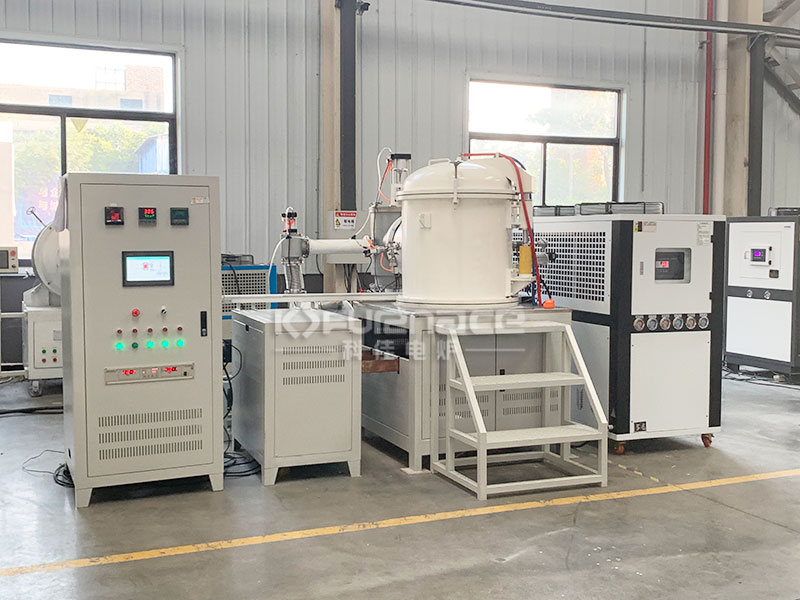
A commonly used small graphite vacuum furnace (click on the image to view product details)
1. Vacuum heat treatment of ceramic materials using graphite vacuum furnace
Ceramic materials are divided into non oxide ceramics and oxide ceramics, as well as advanced ceramics such as silicon carbide, silicon nitride, aluminum oxide, and zirconium oxide. In order to achieve high density and high mechanical properties, sintering treatment must be completed in an oxygen free high-temperature environment. Graphite vacuum furnace is the mainstream processing equipment in the industry.
(1) Sintering of non oxide ceramics (SiC, Si ∝ N ₄)
Silicon carbide and silicon nitride ceramics are prone to oxidation and decomposition when exposed to air at high temperatures, and cannot be sintered in an air environment.
The high vacuum environment inside the graphite vacuum furnace isolates oxygen and heats up to 1800-2200 ℃ to achieve densification and sintering of ceramic bodies, eliminate internal pores, and improve material hardness, wear resistance, and thermal shock resistance. Some processes will be filled with high-purity argon gas and sintered under low-pressure atmosphere to suppress high-temperature decomposition of ceramic components and improve the yield of finished products.
(2) High temperature treatment of oxide ceramics
High purity alumina and zirconia ceramics, as well as some special ceramic composite components, can also be vacuum sintered, annealed, and treated with impurities using a graphite vacuum furnace. A vacuum environment can effectively remove impurities and binder decomposition products from the body, reduce internal porosity defects in the finished product, and improve the purity of ceramic materials.
>Attention: Some oxide ceramics may experience component volatilization under high vacuum. It is necessary to choose high vacuum or low-pressure inert atmosphere mode according to the material characteristics to avoid element loss in the product.
2. Application of Graphite Vacuum Furnace in Carbon Material Vacuum Heat Treatment
Carbon materials include carbon fibers, carbon carbon composite materials, graphite bodies, lithium negative electrodes, carbon based composite materials, etc. The graphite vacuum furnace mainly completes the processes of “carbonization, graphitization, annealing, degassing and purification”.
(1). Graphitization treatment of carbon materials
Under vacuum or argon protection at 2000-2200 ℃, carbon atoms undergo lattice rearrangement in carbon materials, transforming disordered carbon into ordered graphite structures, greatly improving thermal and electrical conductivity. Widely used in the preparation of lithium battery negative electrode materials, carbon fibers, and carbon carbon composite materials. A vacuum environment can effectively remove ash and impurities from the interior of materials, improving the purity of carbon materials.
(2). Annealing and degassing of carbon materials
After pre-treatment, carbon composite components are annealed at high temperature under vacuum to eliminate internal stress, remove residual binders and volatile components inside the billet, and improve the overall stability of the material.
(3). Heat treatment of carbon ceramic composite components
Carbon ceramic composite bodies undergo high-temperature reaction sintering in a vacuum environment to prepare composite materials that are resistant to high temperatures and erosion, and are commonly used in aerospace and new energy components.
3. Process advantages of graphite vacuum furnace for processing ceramics and carbon materials
(1). Ultra high temperature capability: The graphite thermal field can work stably up to 2000-2200 ℃, meeting the requirements of ultra-high temperature processes such as silicon carbide sintering and carbon material graphitization. The equipment cost of metal molybdenum and tungsten thermal fields is higher, and the cost-effectiveness advantage of graphite thermal fields is obvious.
(2). Vacuum+Atmosphere Dual Mode: It can achieve high vacuum and can also introduce inert gases such as argon gas, adapting to the process requirements of different ceramics and carbon materials.
(3). Good uniformity of thermal field: The entire set of graphite heating element+graphite carbon felt insulation structure ensures uniform furnace temperature field and good consistency of heat treatment for the entire batch of products.
(4). Good chemical compatibility: Graphite itself has stable chemical properties under vacuum environment, and does not cause secondary pollution for carbon materials and most ceramics, making it suitable for new material research and mass production.
4. Key points of actual process operation
(1). Control of rubber and degreasing stage
If ceramics or carbon bodies contain organic binders, the low temperature range (200-600 ℃) should not be heated too quickly. Suggest low-speed heating and vacuum extraction to fully extract the decomposition products of the binder from the furnace; Heating up too quickly can cause bubbling and cracking of the billet.
(2). Reasonable switching between vacuum and atmosphere
Ceramics that are prone to decomposition and volatilization should not blindly pursue high vacuum. Adopting a “low argon partial pressure process” can suppress the volatilization of material elements; Carbon material graphitization prioritizes high vacuum impurity removal, followed by the addition of protective gas during the high-temperature stage.
(3). Heating rate control
Ceramic bodies and graphite components both pose a risk of thermal stress. The heating rate of large-sized workpieces should not be too fast to prevent cracking, while also protecting the graphite thermal field and extending the service life of the equipment.
(4). Avoiding carburizing risks
The high temperature of graphite thermal field will produce trace amounts of carbon vapor, which is not affected by the vast majority of ceramics and carbon materials; A few special ceramics that are prone to carburization require isolation crucibles to avoid the influence of carbon elements on the workpiece.
(5). Cooling process
After the process is completed, the furnace cannot be started immediately. It needs to be cooled down along with the furnace to below 200 ℃, and then the furnace door should be opened to prevent high-temperature workpieces from quickly oxidizing in contact with air.
5. Selection reference suggestions
(1). Laboratory small batch samples: choose a small graphite vacuum furnace, pay attention to the highest temperature, ultimate vacuum, and temperature field uniformity.
(2). Industrial mass production: Determine the effective hot zone of the furnace based on the size of the workpiece, prioritize the use of high-purity isostatic graphite thermal field, and match it with mechanical pumps and molecular pump vacuum units to achieve higher vacuum.
(3). Process differentiation: Carbon material graphitization is the main focus, with priority given to ensuring the highest operating temperature of the equipment; Ceramic sintering, with a focus on temperature field uniformity and atmosphere control ability.
Graphite vacuum furnace, with its characteristics of ultra-high temperature and controllable vacuum atmosphere, has become a commonly used equipment for heat treatment of advanced ceramics and carbon based new materials. It can customize furnace size, temperature range, vacuum system configuration according to customer process requirements, and is suitable for scientific research experiments and industrial mass production.Click to learn more customized vacuum furnaces! Or click on online customer service to learn more about product information!
prev: What heat treatment processes can be implemented for the working principle of vacuum tube furnace?
next: the latest article
Contact Information
E-mail: