English
 简体中文
简体中文 Français
 日本語
日本語 한국어
한국어 Português
 Русский
 Español




Tel Number
181-3719-5600
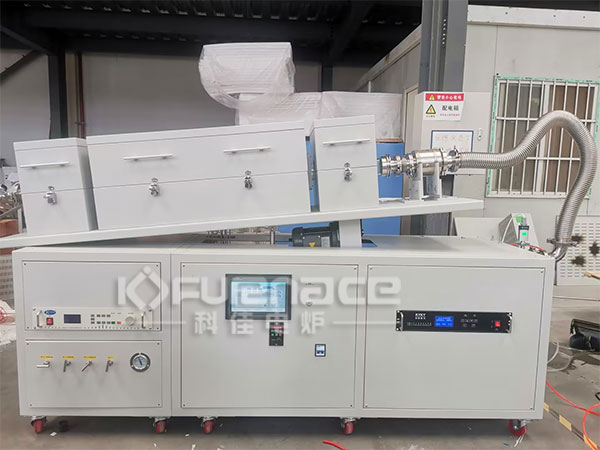
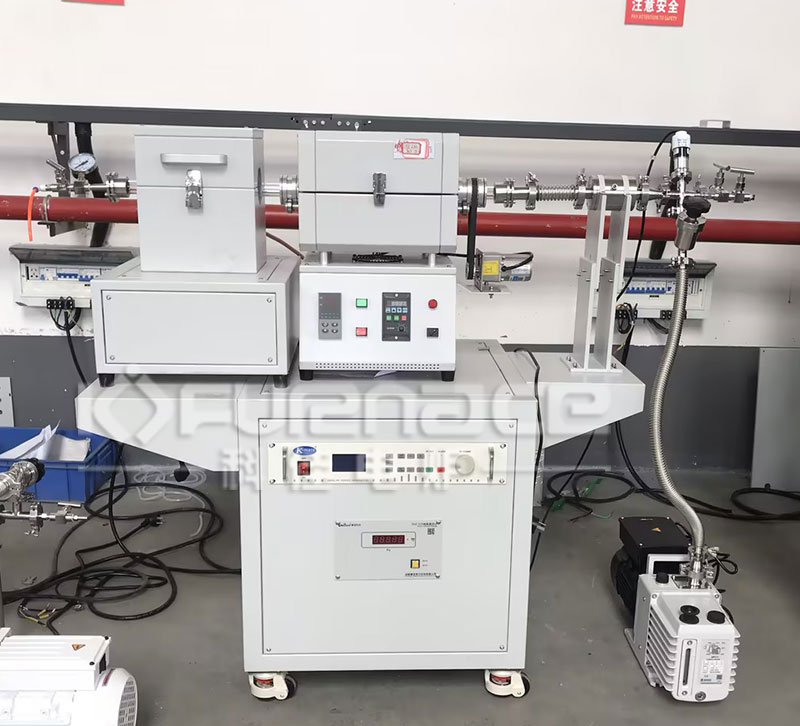
If you need to customize automatic feeding and discharging rotary PECVD equipment, you need to comprehensively consider three dimensions: core functional modules, key technical parameters, and customized design points. Let’s take a detailed look below!
1. Core functional module configuration
rotating system
Furnace tube rotation: It needs to support 360 ° uniform rotation, and the recommended speed range is 0-20rpm, which can be continuously adjusted to ensure that powder or granular materials are evenly flipped during the deposition process, avoiding local overheating or uneven deposition.
Mixing system: Optional independent mixing and rotating device can be equipped to further promote material mixing and improve film uniformity through mixing baffle or spiral structure.
Tilting system: The furnace body needs to support large angle tilting, which is convenient for rapid feeding and unloading, reduces manual operation time, and is especially suitable for mass production scenarios.
Automatic feeding and discharging system
Feeding end: Adopting a “feeding tank+feeding mechanism” design, materials are transported into the furnace tube by pneumatic or mechanical means to avoid manual contact pollution.
Discharge end: equipped with “collection tank+manual auxiliary lifting component”, automatically collects materials after sedimentation is completed, and supports manual adjustment of discharge height to adapt to containers of different specifications.
Sealing design: KF25 or ISO standard flange interfaces should be used for the inlet and outlet, combined with vacuum sealing rings to ensure a low-pressure environment is maintained during the deposition process and prevent gas leakage from affecting the quality of the film.
Vacuum and gas control system
Vacuum system: composed of mechanical pump and vacuum gauge, quickly evacuate to the required process pressure, and monitor the vacuum degree of the chamber in real time.
Gas supply: Equipped with 1-5 high-precision mass flow meters, supporting the mixing and flow control of various process gases (such as SiH ₄, NH ∝, N ₂, etc.) to meet different film deposition needs.
Exhaust system: A ball valve is installed at the exhaust end to control the exhaust rate, and a KF25 suction port is reserved to connect to the exhaust treatment device, ensuring environmental compliance.
Heating and temperature control system
Heating method: Choose resistance wire (≤ 1200 ℃) or silicon carbide rod (1200-1400 ℃) according to temperature requirements. The heating elements should be evenly distributed around the furnace tube to ensure temperature field uniformity (± 5 ℃).
Temperature control system: using fuzzy PID control algorithm, supporting 30 programmable temperature curves, displaying and recording temperature data in real time, with over temperature alarm and thermocouple protection functions.
Cooling system: Optional air or water cooling device can be equipped to accelerate the cooling of the furnace body and shorten the production cycle.
Radio frequency and plasma systems
RF power supply: The output power is continuously adjustable and supports automatic matching network to ensure stable plasma excitation.
Plasma monitoring: Real time feedback of plasma state through spectral analysis or current voltage monitoring, combined with machine learning algorithms to achieve dynamic process closed-loop control and improve film quality.
2. Key technical parameter requirements
Temperature range: Select according to process requirements, such as 950-1000 ℃ for battery material processing, 1200-1400 ℃ for semiconductor film deposition, and ≥ 1500 ℃ for high-temperature applications (such as ceramic sintering).
Pressure range: adjustable, suitable for different gas reaction conditions.
Rotation accuracy: The precision of speed control ensures the uniformity of material flipping.
Temperature control accuracy: ± 1 ℃, to avoid temperature fluctuations affecting film performance.
Gas flow accuracy: Ensure accurate gas ratio.
Equipment size: Customized according to production space, with reserved space for operation and maintenance.
3. Key points of customized design
Furnace tube material and size
Material: Select high-purity quartz (≤ 1200 ℃) or ceramic fiber (≥ 1500 ℃) according to the process temperature to avoid volatile contamination of the sample at high temperatures.
Size: Customize the length and diameter of the furnace tube according to the amount of material, such as a special-shaped tube with a diameter of Φ 60x100x1200mm. The interior can be welded with a stirring baffle or spiral structure to enhance the mixing effect of the material.
Automation control software
Operation interface: It can adopt a full touch screen design, support Chinese/English switching, and intuitively display parameters such as temperature, pressure, and speed.
Process programming: supports the setting and storage of multiple process curves, can schedule unmanned operation, and export experimental data (such as USB interface or network transmission).
Security protection: Integrated alarm functions such as overheating, disconnection, leakage, and overvoltage to ensure the safe operation of the equipment.
Expansion interface and compatibility
Reserved interfaces: such as KF25, ISO flanges, etc., for easy connection to peripheral devices such as exhaust gas treatment, vacuum gauges, spectrometers, etc.
Communication Protocol: Supports industrial communication protocols such as Modbus and TCP/IP, and can be connected to factory automation production lines to achieve remote monitoring and data collection.
Maintenance and Upgrade
Modular design: Key components such as heating elements, RF power supplies, and vacuum pumps are designed with modularity for quick replacement and maintenance.
Software Upgrade: Provides firmware and software upgrade services to continuously optimize device performance and functionality.Click to learn more PECVD devices! Or click on online customer service to learn more about product information!
Contact Information
E-mail: