English
 简体中文
简体中文 Français
 日本語
日本語 한국어
한국어 Português
 Русский
 Español





Tel Number
181-3719-5600
The high vacuum experimental atmosphere muffle furnace is a high-temperature heating equipment that integrates high vacuum environment and controllable atmosphere functions. It is widely used in materials science, metallurgy, ceramics, electronics and other fields. Let’s take a detailed look at the high vacuum experimental atmosphere muffle furnace below!
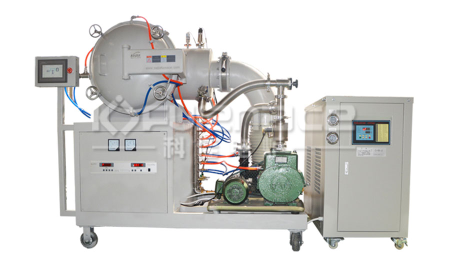
A commonly used high-temperature vacuum brazing furnace (click on the image to view product details)
1. Core functions
Creating a high vacuum environment
Equipped with a rotary vane pump, molecular pump, or diffusion pump system, the vacuum degree inside the furnace can be reduced to 10 ⁻³ Pa to 10 ⁻⁴ Pa, effectively eliminating interference factors such as oxygen and moisture in the air, preventing material oxidation or contamination at high temperatures, and ensuring the accuracy of experimental results. For example, in the sintering process of silicon nitride ceramics, a high vacuum environment can prevent impurities from reacting with oxygen and improve product purity.
Controllable atmosphere regulation
Through gas flow meters and valve components, inert gases (such as nitrogen and argon), reducing gases (such as hydrogen), or mixed gases can be introduced into the furnace to create a protective or reactive atmosphere. For example, in the preparation of metal based composite materials, introducing a hydrogen nitrogen mixture can prevent matrix oxidation and promote material interface reactions.
High temperature heating and precise temperature control
By using silicon carbide rods, resistance wires or graphite heating elements, combined with high-precision thermocouples and PID controllers, precise control of heating rate and insulation time can be achieved. The temperature range is usually from room temperature to 1800 ℃, and some models can reach 2200 ℃. The temperature difference can be controlled within ± 5 ℃ to meet the temperature curve requirements of different materials.
Security protection mechanism
Equipped with devices such as over temperature protection, leakage protection, and gas leak detection, especially when using flammable and explosive gases (such as hydrogen), it can reduce safety risks. For example, when the temperature inside the furnace exceeds the set value, the system automatically cuts off the heating power to prevent equipment damage or fire.
2. Technical parameters
Maximum operating temperature: 1500-2200 ℃ (depending on the model), meeting the requirements of high-temperature processes such as metal melting and ceramic sintering.
Vacuum degree: 10 ⁻³ Pa to 10 ⁻⁴ Pa. For ordinary vacuum requirements, a rotary vane pump system can be selected, while for high vacuum requirements, a molecular pump is required.
Furnace size: The minimum furnace size can be 150mm in length, width, and height, while larger ones can be made up to 1000mm. The size can be customized according to experimental requirements to ensure uniform heating of the sample.
Temperature control accuracy: within ± 1 ℃ (high-precision model), suitable for temperature sensitive experiments such as semiconductor doping.
Cooling method: air cooling or water cooling, depending on efficiency requirements. Water cooling can accelerate the cooling process.
Material: The furnace body is made of high-temperature resistant materials such as graphite, ceramics, or precious metals, and the heating element is made of silicon carbon rods or resistance wires to ensure the equipment’s heat resistance and corrosion resistance.
3. Application Fields
Material sintering and preparation
Ceramic materials: Sintering non oxide ceramics such as silicon nitride and silicon carbide in an inert atmosphere to avoid high-temperature oxidation.
Composite materials: Prepare metal based composite materials, such as aluminum based silicon carbide composite materials, in a reducing atmosphere to enhance material strength and wear resistance.
Metal materials: Performing processes such as metal melting, deoxidation, and degassing, such as vacuum melting of titanium alloys, to improve material purity.
Material Decomposition Experiment
Control the atmospheric environment to study the decomposition behavior and products of minerals and catalysts at high temperatures. For example, decomposing metal oxides in a hydrogen atmosphere to prepare high-purity metal powders.
Aerospace material testing
Simulate harsh environments: Test the high-temperature stability and thermal shock resistance of spacecraft materials in vacuum or low-pressure atmospheres.
Coating performance verification: Conduct atmosphere aging tests on high-temperature protective coatings (such as antioxidant coatings) to evaluate their service life.
Electronic material processing
Thin film growth: By controlling the temperature and atmosphere, the crystal structure and properties of the thin film are controlled to improve the growth rate and quality of the thin film. For example, growing gallium nitride thin films on silicon substrates for manufacturing high-frequency power devices.
Optical material processing: Heat treatment of optical glass in a specific atmosphere to eliminate internal stress and improve optical performance.
4. Selection suggestions
temperature range
Select according to material processing requirements: For general metal heat treatment, choose models below 1200 ℃, for ceramic sintering, choose models above 1600 ℃, and for high-temperature alloy melting, choose models above 2000 ℃.
Vacuum degree and atmosphere type
For ordinary vacuum requirements (such as metal annealing), a rotary vane pump system (10 ⁻ ³ Pa) can be selected.
High vacuum requirements (such as semiconductor material preparation) require molecular pumps (10 ⁻⁴ Pa).
When dealing with flammable and explosive gases (such as hydrogen), it is necessary to confirm that the equipment has explosion-proof design and is equipped with gas leak detection devices.
furnace size
Choose length and volume based on sample size: powder samples can be selected in small sizes (such as φ 150mm), block samples require large sizes (such as φ 1000mm), and long samples require customized furnace size.
temperature control accuracy
For temperature sensitive experiments (such as semiconductor doping), high-precision models within ± 1 ℃ should be selected.
Ordinary materials can be sintered with conventional models at ± 5 ℃ to reduce costs.Click to learn more customized vacuum furnaces! Or click on online customer service to learn more about product information!
Contact Information
E-mail: