English
 简体中文
简体中文 Français
 日本語
日本語 한국어
한국어 Português
 Русский
 Español




Tel Number
181-3719-5600
The three temperature zone high-temperature rotary tube furnace is a commonly used heat treatment equipment that integrates independent temperature zone control, rotary heating, and efficient insulation. Its core advantages lie in temperature gradient control, uniform rotary heating mechanism, energy-saving and environmentally friendly design, and intelligent operation function. It is suitable for complex process requirements in materials science, chemistry, physics, electronics and other fields. Let’s take a detailed look at the three temperature zone high-temperature rotary tube furnace below!
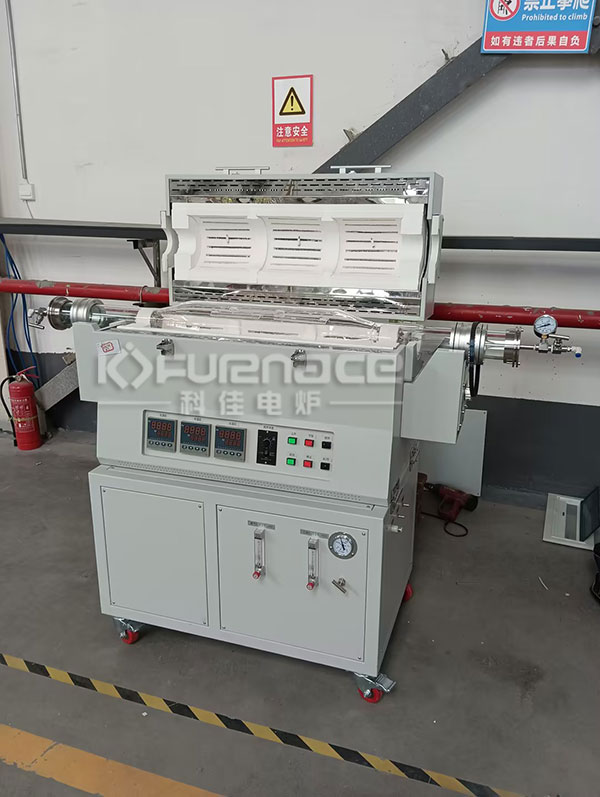
Customized Multi Gradient Rotating Tube Furnace (Click on the image to view product details)
1. Technical features: Integration of good temperature control and uniform heating
Three temperature zone independent control
The equipment is equipped with three independent heating zones, each of which can be individually set in temperature (such as 1700 ℃ in the central zone and 1400 ℃ on both sides), forming a good temperature gradient. For example, in the preparation of functional materials, directional growth under thermal gradient can be achieved by adjusting the temperature zone to avoid cracking or performance differences caused by uneven temperature.
Rotating heating mechanism
The furnace tube can rotate clockwise or counterclockwise (with adjustable speed) to promote uniform distribution of atmosphere inside the furnace and enhance the surface heat exchange efficiency of the material. For example, in powder metallurgy processes, rotary heating can make the powder particles heated more evenly, react more fully, and improve material density.
Good insulation and energy-saving design
The furnace is made of high-temperature resistant materials such as high-purity alumina fibers or corundum tubes, combined with a double-layer shell and air cooling system, with a surface temperature below 60 ℃ to reduce heat loss. Some models use silicon molybdenum rods for heating, which has lower energy consumption and is in line with the trend of green production.
Intelligent operation and security protection
Equipped with PID intelligent temperature control system, supporting 30 stage program temperature control, with a temperature control accuracy of ± 1 ℃. At the same time, it integrates multiple protection functions such as overheating, disconnection, and overpressure to ensure that the equipment automatically shuts down in case of abnormal situations, ensuring operational safety.
2. Application scenario: covering the needs of multiple fields of scientific research and industry
material preparation
Nanomaterial synthesis: directional growth of one-dimensional materials such as nanowires and fibers is achieved through temperature gradient control.
Ceramic sintering: Rotating heating promotes uniform shrinkage of ceramic particles, reduces defects, and improves sintering quality.
Metal heat treatment: Reduction of metal oxides in a reducing atmosphere (such as hydrogen) to prepare high-purity metal powders.
semiconductor process
Thin film epitaxial growth: using CVD method to deposit thin films under temperature gradient, controlling lattice matching and improving device performance.
Wafer Annealing: Vertical airflow design reduces temperature fluctuations, ensuring that the temperature difference on the wafer surface is controlled within ± 5 ℃, meeting the precision requirements of semiconductor manufacturing.
Research on Chemical Catalysis
Catalyst preparation: Rotating heating evenly decomposes the catalyst precursor, optimizes the pore structure, and improves catalytic activity.
Gas phase reaction: The multi-channel atmosphere control system can introduce protective gases such as nitrogen and argon to prevent oxidation of reactants and improve product purity.
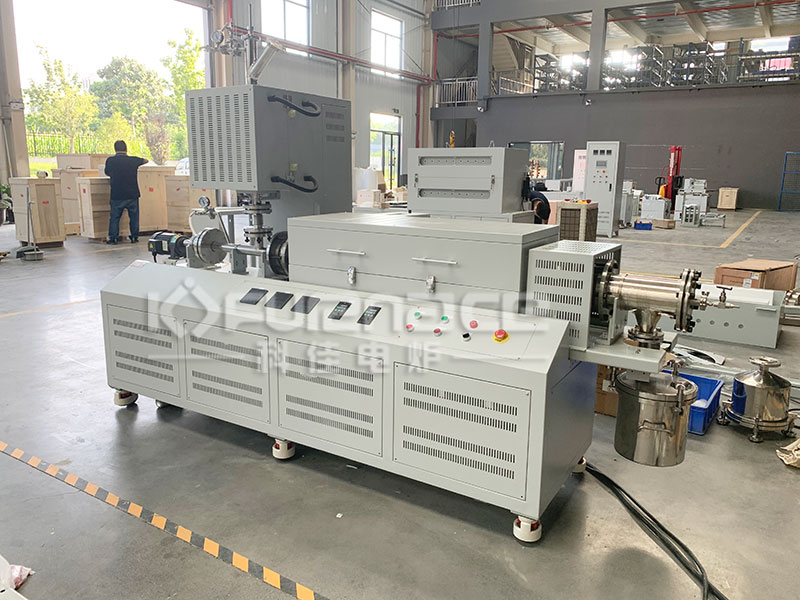
Customized rotary tube furnace with preheating (click on the image to view product details)
3. Performance advantages
performance advantage
Temperature gradient controllable: By adjusting the temperature in the three temperature zones, complex heat treatment environments can be simulated, such as the phase transition behavior of materials during rapid heating insulation cooling processes.
Rotating heating uniformity: The rotation of the furnace tube makes the sample heated more evenly, especially suitable for the processing of powder or granular materials.
Energy saving and environmental protection: Efficient insulation materials and intelligent temperature control systems reduce energy consumption, meeting the energy-saving needs of laboratories or industrial production.
Application Cases
Calcination of positive electrode materials for lithium-ion batteries: Rotating heating reduces particle size distribution deviation and improves battery cycling performance.
Graphene growth: Microwave assisted CVD combined with rotational heating increases growth rate.Click to learn more customized tube furnaces! Or click on online customer service to learn more about product information!
Contact Information
E-mail: