English
 简体中文
简体中文 Français
 日本語
日本語 한국어
한국어 Português
 Русский
 Español




Tel Number
181-3719-5600
The vacuum furnace that can pass gas combines the functions of vacuum environment and gas introduction, showing great advantages in material processing, heat treatment, experimental research and other fields. Let’s take a detailed look below!

KJ-VS1700-12CWG vacuum sintering furnace (click on the picture to view product details)
1. Protect the atmosphere function, prevent material oxidation and pollution
Inert gas protection:
Introducing inert gases such as argon and nitrogen into a vacuum furnace can create a protective atmosphere, effectively isolating oxygen and preventing materials such as metals and ceramics from oxidizing at high temperatures. For example, in metal heat treatment, inert gases can prevent the formation of oxide scale on the surface of the workpiece, maintain surface smoothness, and reduce subsequent processing costs.
Reduce impurity pollution:
The vacuum environment itself has significantly reduced the content of gas impurities. Introducing high-purity inert gas can further reduce the residual active gases such as oxygen and nitrogen in the furnace, avoiding material contamination during sintering or heat treatment, especially suitable for semiconductor materials, optical components, etc. that require high purity.
2. Control the reaction atmosphere to meet specific process requirements
Nitriding treatment:
By introducing ammonia or nitrogen gas, a nitride layer can be formed on the metal surface, improving the corrosion resistance and fatigue strength of the material. Nitriding treatment in a vacuum environment can reduce the risk of hydrogen embrittlement and is suitable for high-precision parts such as aircraft engine blades and mold steel.
Restoring atmosphere:
By introducing reducing gases such as hydrogen or carbon monoxide, metal oxides can be reduced, achieving purification of metals or surface removal of oxide layers. For example, in rare earth metal purification, passing hydrogen gas through a vacuum furnace can efficiently remove impurities and improve product purity.
3. Optimize heat treatment effect and improve material properties
Uniform heating and cooling:
Gas injection can improve the temperature uniformity inside the furnace, especially for large-sized or complex shaped parts. Gas flow can reduce local temperature differences and avoid cracking or deformation caused by thermal stress. For example, in the quenching of large gears, introducing argon gas can ensure uniform temperature and improve quenching quality.
Control cooling rate:
By adjusting the gas flow rate and pressure, the cooling rate of the workpiece can be better controlled, achieving graded quenching or isothermal quenching, and optimizing the microstructure of the material. For example, in the heat treatment of high-speed steel, passing nitrogen gas through the vacuum furnace can achieve slow cooling and avoid cracks caused by rapid martensitic transformation.
Reduce decarbonization and increase carbon emissions:
Introducing specific gases in a vacuum environment can suppress decarburization (carbon loss) or carbonization (carbon infiltration) on the metal surface, maintaining the stability of the material’s chemical composition. For example, in the heat treatment of bearing steel, introducing methane can prevent surface decarburization and improve fatigue life.
4. Improve production efficiency and safety
Rapid temperature rise and fall:
Gas injection can assist in heat exchange inside the furnace, reducing heating and cooling time. For example, in vacuum sintering, introducing argon gas can accelerate cooling, reduce production cycles, and improve equipment utilization.
Safety protection
For flammable and explosive gases (such as hydrogen), vacuum furnaces can be equipped with gas leak detection and automatic cut-off systems, combined with inert gas dilution, to reduce the risk of explosion. Meanwhile, the vacuum environment itself reduces the contact between gas and oxygen, further ensuring safety.
Automated control:
Modern vacuum furnaces can integrate automated systems such as gas flow control, pressure monitoring, and temperature programming to achieve precise control of process parameters, reduce human operational errors, and improve production consistency and repeatability.
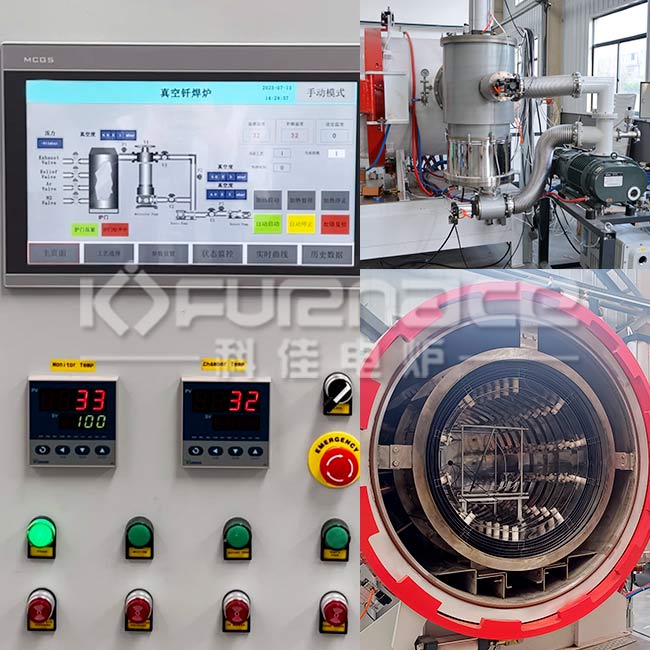
Metal insulation screen experimental vacuum furnace (click on the picture to view product details)
5. Adapt to diverse material and process requirements
Ceramic sintering:
In ceramic sintering, introducing nitrogen or argon gas can prevent the ceramic from reacting with oxygen at high temperatures, while gas pressure can suppress abnormal grain growth, improve ceramic density and mechanical properties.
Preparation of composite materials:
In the preparation of metal based or ceramic based composite materials, the introduction of reaction gases (such as carbon and nitrogen sources) can achieve in-situ synthesis, enhance interfacial bonding strength, and improve the overall performance of the material.
Experimental research:
In materials science research, the gas passing function of vacuum furnaces can simulate specific atmospheric environments, study the behavior of materials under extreme conditions, and provide experimental platforms for the development of new materials.Click to learn more customized vacuum furnaces! Or click on online customer service to learn more about product information!
Contact Information
E-mail: