English
 简体中文
简体中文 Français
 日本語
日本語 한국어
한국어 Português
 Русский
 Español




Tel Number
181-3719-5600
At present, with the upgrading of traditional fuel vehicles and the rapid popularization of new energy vehicles, car companies are iterating towards lightweight, high heat dissipation efficiency, long component life, and airtight reliability. Many multi-layer flow channels, heterogeneous metal composites, and precision sealed structural parts are prone to defects such as weld oxidation, residue corrosion, internal porosity, and pressure leakage in ordinary welding and atmosphere brazing.
The vacuum brazing furnace relies on a sealed high vacuum chamber, accurate temperature control in different zones, and flux free welding technology to complete complex multi weld metallurgical bonding in one go. The welds are dense, clean, and resistant to high temperature vibration. It has become a commonly used thermal treatment equipment for the processing of core components of fuel vehicles and new energy vehicles. Below, we will provide a detailed overview of the process advantages of vacuum brazing furnaces, various scenarios for the landing of automotive components, key points of material selection processes, and equipment selection guidelines, which can serve as a reference for component processing plants and equipment procurement personnel.
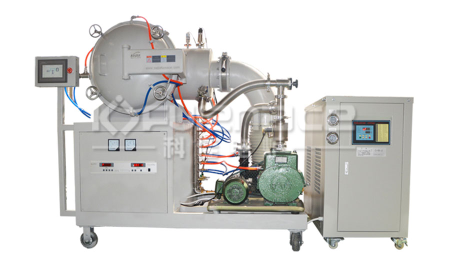
A commonly used high-temperature vacuum brazing furnace (click on the image to view product details)
1. The core advantages of vacuum brazing technology in adapting to automotive processing
High temperature insulation and oxidation, clean and residue free welds
The interior of the furnace is evacuated to a high vacuum environment, and aluminum alloys, stainless steel, and nickel based alloys will not form oxide films at high temperatures; Aluminum alloy brazing relies on the volatilization of magnesium element to remove surface aluminum oxide, without the need for soldering flux throughout the process. There will be no corrosive residue left inside the workpiece, eliminating the hidden dangers of blockage and corrosion leakage in the cooling water circuit in the later stage.
Complex structure formed in one go, multi-layer flow channels sealed as a whole
Plate coolers, honeycomb components, and multi-channel water cooling plates have dozens of fine flow channels. Under vacuum conditions, the brazing material relies on capillary flow to fill all gaps. With one heating, dozens of weld seams can be welded, making it suitable for large-scale precision parts production.
Can achieve welding of dissimilar metals
It can achieve reliable connections between aluminum copper, stainless steel high-temperature alloy, and metal ceramic substrates, and is suitable for composite material accessories such as automotive IGBT power substrates and conductive copper bars, helping to reduce the weight of vehicle components.
Stable weld strength, vibration resistance, and resistance to high and low temperature cycles
Brazing joints belong to metallurgical grade fusion structures, which can withstand vehicle driving vibrations and repeated cold and hot impacts. The welds are not easy to crack and release pressure, extending the service life of heat dissipation components and oil circuit accessories.
2. Subdivision of mainstream automotive component applications using vacuum brazing furnaces
(1). New energy vehicle power battery cooling components (currently in high demand)
During operation, power batteries release a large amount of heat, and uneven temperature directly affects battery life and safety. The aluminum alloy liquid cooling plate is made of double-layer aluminum plates stamped with cooling liquid channels, which are vacuum brazed together to form a closed and pressure resistant flow channel with uniform thermal conductivity.
In addition, the water-cooled heat dissipation substrate, copper aluminum connection row for battery cells, IGBT controller water-cooled heat sink, and motor housing cooling interlayer are all commonly processed using vacuum brazing technology.
(2). Vehicle heat exchange system accessories (universal for fuel vehicles and new energy vehicles)
Automobile air conditioning evaporator, condenser, warm air radiator;
EGR exhaust gas recirculation cooler, engine oil cooler, turbocharger cooling chamber;
Plate heat exchangers and oil-water heat exchange components.
Aluminum alloy heat dissipation parts require smooth and clean internal pipelines, and vacuum brazing without flux can avoid the problem of flux residue blocking micro pipelines.
(3). Engine and turbocharged high-temperature components
The turbocharger impeller housing, high-temperature pipelines, fuel injector components, and engine sensor sealing housing are mostly made of stainless steel and nickel based heat-resistant alloys.
Ordinary welding is prone to oxidation and embrittlement under high temperature conditions; Vacuum brazing ensures that the weld seam is resistant to high temperatures and high-temperature gas corrosion, and is suitable for the harsh high-temperature environment of the engine compartment.
(4). Brake, hydraulic pipeline and precision valve body parts
Automotive hydraulic brake valves, oil circuit diversion components, and multi-layer sealed valve bodies have intricate internal oil passages.
Vacuum brazing can seal multiple layers of cavities in one go, with good air tightness, and high-pressure brake oil can be pressurized for a long time without any gaps or leaks.
(5). Vehicle mounted power electronics, sensor airtight housing
The housing of the autonomous driving sensor, the on-board power module, and the DBC ceramic metal substrate need to be insulated, sealed, dust-proof, and moisture-proof. Vacuum environment enables brazing and bonding between ceramics and metals, with no impurities in the weld seam, ensuring long-term stable operation of automotive electronic components.
3. Key points of vacuum brazing process corresponding to workpieces of different materials
(1). Aluminum alloy parts (cold plate, radiator)
Maintain the working vacuum degree within 5 × 10 ⁻ ³ Pa, control the processing temperature between 580-620 ℃, and use aluminum silicon brazing material; Relying on a vacuum environment, magnesium vapor is used to peel off the aluminum oxide film without the need for flux throughout the process.
(2). Stainless steel and heat-resistant alloy accessories
Using copper based and nickel based brazing materials, the heating rate is slowed down to reduce workpiece deformation, making it suitable for turbine components and high-temperature pipelines.
(3). Aluminum copper dissimilar metal connectors
Set up gradient heating process, control the insulation time, avoid the formation of brittle compounds between metals, and ensure the conductivity and structural strength of conductive copper bar joints.
4. Suggestions for Automotive Parts Processing Plants to Choose Vacuum Brazing Furnaces
The mass production of automotive parts has strict standards for vacuum stability and furnace temperature uniformity. When selecting equipment, it is important to refer to the following parameters:
Furnace vacuum degree: It is recommended that the maximum vacuum of the equipment for processing aluminum alloy workpieces be better than 6.67 × 10 ⁻ ³ Pa;
Optional air-cooled and water-cooled rapid cooling structures can be used to shorten the single process cycle and improve the production capacity of the assembly line;
The furnace chamber, heating graphite components, and molybdenum insulation screen support customization, and the furnace size can be customized according to the size of the workpiece.
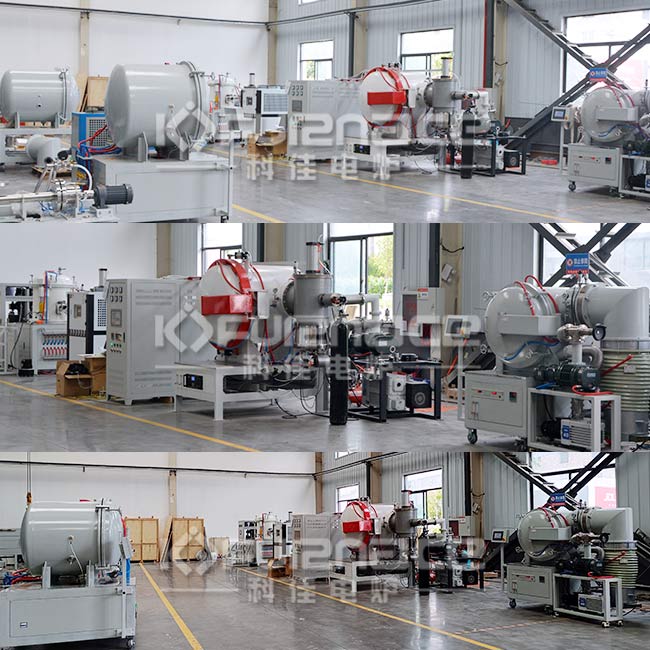
Molybdenum screen vacuum brazing furnace (click on the picture to view product details)
Conclusion
With the upgrading of automotive lightweighting and new energy cooling technology, the production capacity of multi-layer water-cooled plates, precision heat exchangers, and high-temperature turbine components continues to rise. Compared with atmosphere brazing and flame brazing, vacuum brazing furnace has become a commonly used heat treatment equipment for automotive parts production due to its advantages of no oxidation, no residue, good sealing, and adaptability to welding of dissimilar materials. Component manufacturers can choose non-standard customized high-temperature vacuum brazing furnaces based on workpiece material, size, and batch production capacity.Click to learn more customized vacuum furnaces! Or click on online customer service to learn more about product information!
Contact Information
E-mail: