English
 简体中文
简体中文 Français
 日本語
日本語 한국어
한국어 Português
 Русский
 Español




Tel Number
181-3719-5600
In the fields of powder metallurgy, advanced ceramics, new material research and development, and industrial mass production, high-temperature sintering technology directly determines the density, purity, mechanical properties, and finished product qualification rate of materials. Ordinary high-temperature electric furnaces have problems such as uneven temperature field, easy oxidation, insufficient temperature resistance, and residual impurities, which make it difficult to meet the processing needs of high-precision metal powders and special ceramic materials. As a high-performance ultra-high temperature vacuum heat treatment equipment, graphite heating vacuum furnace relies on high-purity graphite thermal field and high vacuum sealed environment to achieve stable sintering at ultra-high temperatures above 2000 ℃, better adapting to high-temperature sintering, degreasing, and densification treatment of various metal powders and ceramic materials. It is currently the mainstream vacuum sintering equipment in the new materials industry. Below, we will introduce its working principle, core advantages, compatible materials, and industry applications.

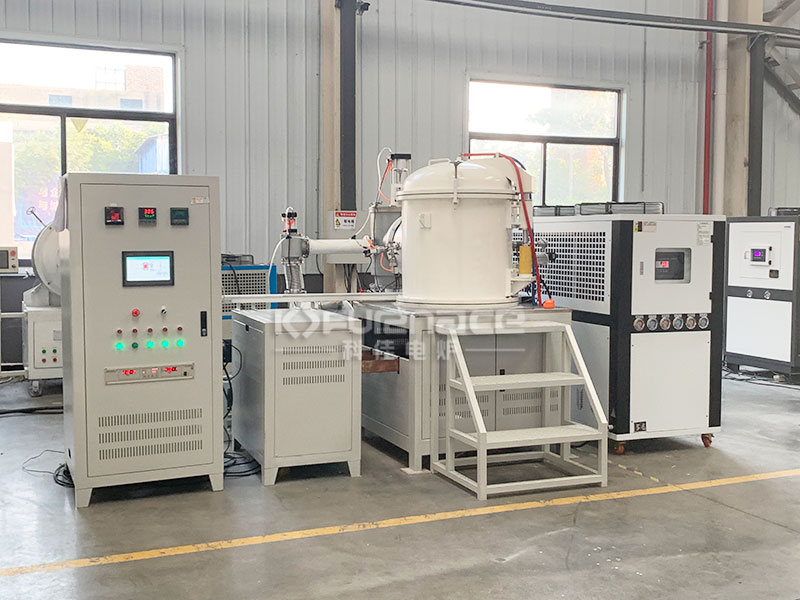
KJ-VS1700-12CWG vacuum sintering furnace (click on the picture to view product details)
1. Working principle of graphite heating vacuum furnace
The graphite heating vacuum furnace is a professional sintering equipment composed of high-purity graphite as the heating element, graphite carbon felt composite insulation structure, high vacuum unit, and intelligent temperature control system. The equipment utilizes the excellent electrical and thermal conductivity, high temperature resistance, and thermal shock resistance of graphite. After being powered on, it achieves uniform heating of the furnace through Joule heating radiation, with a maximum working temperature of 2000 ℃ -2200 ℃, far exceeding conventional resistance furnaces.
When the equipment is running, the vacuum unit quickly extracts the air, water vapor, and impurity gases inside the furnace, creating a high vacuum sealed environment, completely isolating oxygen, and preventing material high-temperature oxidation, decarburization, and discoloration problems. At the same time, the vacuum environment can reduce the boiling point of low melting point impurities and adsorbed gases, allowing residual binders, water vapor, and volatile impurities inside the material to be fully discharged, achieving degreasing and purification. Combined with multi-stage temperature control processes, metal powder and ceramic powder particles can be fully melted and diffused, completing densification sintering and forming, greatly improving the comprehensive performance of the material.
2. Core structure and performance advantages of graphite heating vacuum furnace
Compared to molybdenum heating, tungsten heating vacuum furnaces, and ordinary box type sintering furnaces, graphite heating vacuum furnaces have outstanding advantages in high temperature resistance, temperature field uniformity, process adaptability, and cost-effectiveness, better matching the sintering process requirements of powder materials.
(1). High purity graphite thermal field, stable operation at ultra-high temperatures
The equipment adopts high-purity graphite heating element, combined with multi-layer graphite soft felt and hard felt insulation layer. The melting point of graphite material is as high as 3650 ℃, with high temperature resistance, small heat capacity, fast heating rate, strong thermal stability, and is not easy to deform or age. The entire process relies on uniform heating through thermal radiation, with a uniform furnace temperature field and a temperature difference that can be controlled within ± 5 ℃. This solves the problems of over burning, under burning, and color difference in the final product of powder burning, ensuring consistent performance of the entire batch of materials.
(2). High vacuum sealed environment, higher material purity
Equipped with multi-stage vacuum pump units, it can achieve high vacuum operation and effectively remove oxygen, water vapor, and various impurity gases in the furnace. For the sintering of metal powder and ceramic powder, it can avoid problems such as high-temperature oxidation, surface peeling, and impurity doping. At the same time, it can discharge the internal binders, lubricants, and adsorbed gases of the powder green body, achieve the integration of degreasing and sintering, greatly improve the density and purity of materials, and adapt to high-precision material production standards.
(3). Stable and durable operation, good cost-effectiveness
The graphite thermal field structure has strong thermal shock resistance, and is not easily cracked or powdery after repeated temperature rise and fall. It has a long service life and low maintenance costs. Compared with tungsten and molybdenum heating vacuum furnaces, the equipment cost is lower, the temperature range is wider, and it can operate stably at 2000 ℃+ultra-high temperature conditions for a long time, balancing process accuracy and production efficiency. It is a cost-effective equipment in the field of powder sintering.
(4). Multiple security protections, capable of unmanned operation
The equipment is equipped with multiple protection mechanisms such as overtemperature alarm, overtemperature power-off, thermocouple fracture protection, overcurrent and overvoltage protection, and vacuum abnormal alarm, which monitor the equipment’s operating status in real-time throughout the process and automatically warn of faults and shut down. The whole machine has a high degree of automation, stable operation, low failure rate, supports long-term continuous operation and unmanned operation, and is suitable for large-scale production needs.
3. Core compatible materials: sintering applications of metal powders and ceramic materials
The graphite heating vacuum furnace specifically solves the pain points of high-temperature sintering of powder materials, and has good sintering effects on various refractory metal powders, alloy powders, and special ceramic powders, with a wide range of applications.
(1). Sintering of various metal powders
Widely applicable for vacuum sintering and densification treatment of metal powder materials such as hard alloy powder, tungsten powder, molybdenum powder, titanium alloy powder, stainless steel powder, copper based powder, iron-based powder, etc. It can effectively eliminate oxidation, porosity, and impurities during the sintering process of metal powder, improve the hardness, wear resistance, density, and mechanical stability of alloy materials, and is widely used in the production and processing of hard alloy cutting tools, powder metallurgy parts, precision metal components, and MIM metal injection molding products.
(2). Sintering of special ceramic materials
Suitable for high-temperature sintering and annealing treatment of various advanced ceramic materials such as silicon carbide ceramics, silicon nitride ceramics, alumina ceramics, zirconia ceramics, ceramic substrates, functional ceramics, structural ceramics, etc. Ultra high temperature uniform temperature field can fully crystallize and compact ceramic powder, effectively improving the high temperature resistance, corrosion resistance, high insulation, and high strength characteristics of ceramic materials, meeting the production needs of precision ceramic parts in the fields of new energy, electronics, precision machinery, and aerospace.
4. Mainstream industry application areas
With its core advantages of ultra-high temperature, high purity, high precision, and high adaptability, graphite heating vacuum furnaces have become the core heat treatment equipment in multiple high-end manufacturing industries.
(1). Powder metallurgy industry: used for vacuum sintering and debinding of hard alloys, metal ceramics, and powder metallurgy components to improve product accuracy and service life.
(2). Advanced Ceramic Industry: High temperature dense sintering of special structural ceramics, functional ceramics, and ceramic components, suitable for mass production and research and development of precision ceramics.
(3). New energy and new materials industry: High temperature purification and sintering modification of new energy powder materials, energy storage materials, carbon based materials, and graphite materials.
(4). Research in the field of universities: new material sintering experiments, powder process debugging, sample testing, project research and development, with traceable experimental data.
(5). Precision manufacturing industry: High temperature heat treatment processing of precision alloy components, shaped powder parts, and aerospace refractory metal parts.
5. Equipment selection and customization instructions
High quality graphite heating vacuum furnaces can be customized according to user process requirements, supporting multi-dimensional customization such as maximum temperature, furnace size, vacuum degree, gas system, temperature control program, and automation configuration. Whether it is small-scale laboratory experimental equipment or large-scale industrial production equipment, they can be matched according to demand to better adapt to the sintering process of different specifications of metal powders and ceramic materials.
The equipment adopts an integrated modular design, which is easy to install and debug, and easy to maintain in the later stage. The manufacturer can provide one-stop services including scheme design, production and manufacturing, on-site installation, technical training, and lifelong after-sales service. If you have high temperature sintering needs for metal powders and ceramic materials, and would like to know detailed equipment parameters, customized configuration plans, and quotations, please feel free to consult via private message at any time!Click to learn more customized vacuum furnaces! Or click on online customer service to learn more about product information!
Contact Information
E-mail: