English
 简体中文
简体中文 Français
 日本語
日本語 한국어
한국어 Português
 Русский
 Español




Tel Number
181-3719-5600
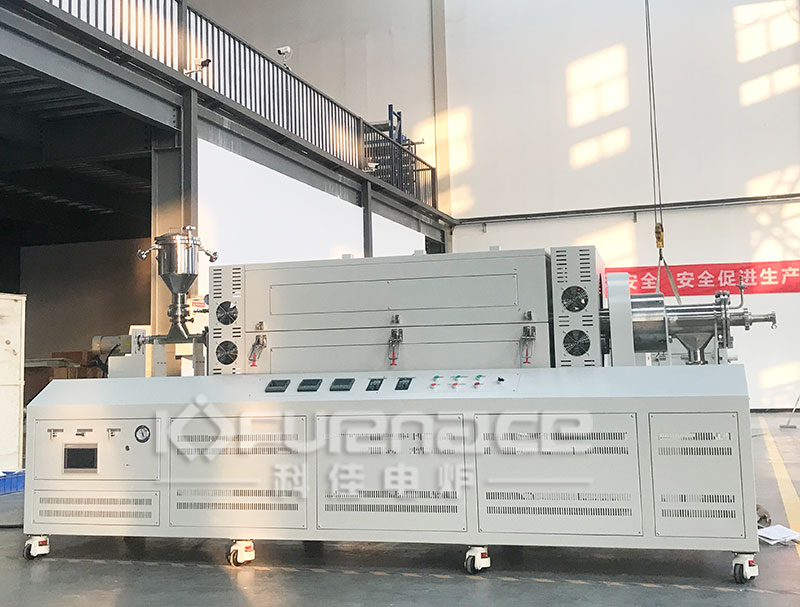
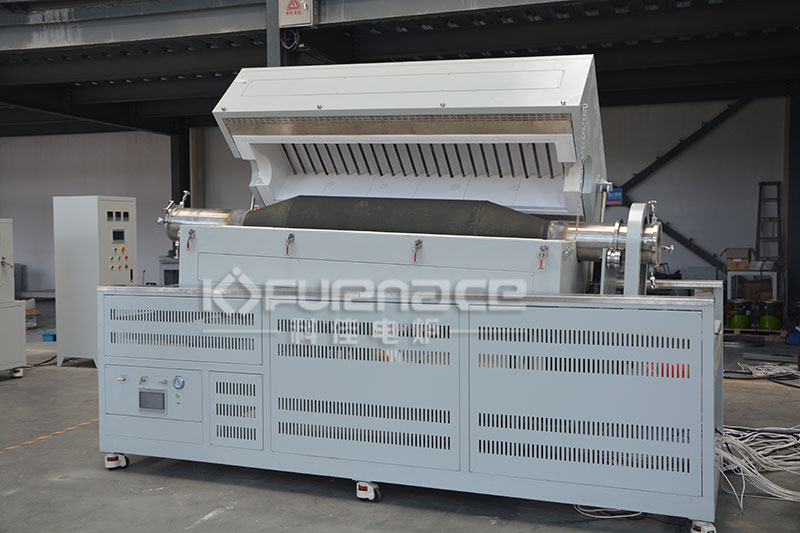
The temperature field of a multi zone rotating tube furnace is usually more uniform, and its uniformity advantage comes from various factors such as structural design, rotation mechanism, and multi zone collaborative control. Let’s take a detailed look below!
1. Structural design advantage: promotes heat transfer and distribution
Rotation mechanism
Dynamic mixing: The rotary tube furnace rotates the tube body (usually running at a speed of 1-10 revolutions per minute) to continuously flip the material during the heating process. This dynamic mixing effect breaks the local temperature gradient that may occur during static heating, ensuring that the heating time of each part of the material is consistent and reducing temperature field unevenness caused by static heating.
Enhanced convection: The airflow disturbance generated by rotation promotes gas convection inside the furnace, accelerating heat transfer, especially for processes involving gas media such as CVD deposition and atmosphere protection treatment, which have better effects.
Material and shape of the pipe body
High thermal conductivity materials: The pipe body is often made of high thermal conductivity materials such as quartz, ceramics, or metals (such as stainless steel) to reduce heat transfer resistance and make temperature distribution more uniform along the axial and radial directions of the pipe body.
Thin walled design: Optimizing the thickness of the pipe wall (usually 1-5mm), reducing heat capacity, shortening temperature response time, and avoiding local overheating or underheating.
2. Multi zone collaborative control: precise zone temperature regulation
Independent temperature control system
Partition heating: The multi temperature zone rotary tube furnace divides the furnace into 2-6 independent heating zones, each equipped with an independent temperature control unit (such as PID controller), which can set gradient temperature according to different process requirements. For example, during the material sintering process, accurate temperature control can be achieved in the heating zone, insulation zone, and cooling zone.
Temperature superposition effect: By adjusting the temperature parameters of each temperature zone, heat forms a superposition effect inside the tube body, compensating for the end heat dissipation loss and further reducing the axial temperature difference.
Intelligent feedback regulation
Thermocouple layout: Multiple thermocouples are arranged at key positions of the pipe body (such as inlet, middle, and outlet) to monitor temperature in real time and provide feedback to the control system. If the temperature in a certain area deviates from the set value, the system automatically adjusts the heating power to maintain a stable temperature field.
Software algorithm optimization: Using fuzzy control or neural network algorithms to predict temperature trends based on historical data, intervene and adjust in advance, and reduce overshoot or undershoot phenomena.
3. Comparison of Temperature Field Uniformity: Differences from Traditional Furnace Types
Multi zone rotary tube furnace:
Axial temperature difference: ≤± 5 ℃ (coordinated control of multiple temperature zones)
Radial temperature difference: ≤± 3 ℃ (rotating mixing+high thermal conductivity pipe body)
Temperature fluctuation range: ≤± 3 ℃ (PID control+intelligent feedback)
Applicable processes: high-precision requirements such as atmosphere treatment, CVD deposition, gradient sintering, etc
Traditional single temperature zone tube furnace:
Axial temperature difference: ≤± 15 ℃ (natural diffusion in a single temperature zone)
Radial temperature difference: ≤± 10 ℃ (static heating, large difference between center and edge)
Temperature fluctuation range: ≤± 8 ℃ (open-loop control or simple temperature control)
Applicable processes: general heat treatment, simple annealing
Traditional muffle furnace:
Axial temperature difference: ≤± 20 ℃ (static heating, significant end heat dissipation)
Radial temperature difference: ≤± 15 ℃ (larger furnace size, greater temperature gradient)
Temperature fluctuation range: ≤± 5 ℃ (manually adjusted or simple PID)
Applicable processes: Burning, ashing, conventional heat treatment
4. Practical application case: Verification of temperature field uniformity
Case 1: Synthesis of carbon nanotubes
Process requirement: Carbon source gas needs to be uniformly deposited within the temperature range of 600-800 ℃ to avoid local overheating and structural defects in carbon nanotubes.
Equipment selection: Adopting a 3-level rotating tube furnace with gradient temperature settings (inlet 600 ℃, middle 750 ℃, outlet 800 ℃) and a rotation speed of 5 revolutions per minute.
Result: SEM images showed an improvement in the uniformity of carbon nanotube diameter and a decrease in defect rate, verifying the influence of temperature field uniformity on material quality.
Case 2: Sintering of positive electrode materials for lithium batteries
Process requirement: Insulation at 900 ℃ for 2 hours is required to ensure uniform growth of LiCoO ₂ crystal structure.
Equipment selection: 4-zone rotary tube furnace, with a constant temperature zone (900 ℃± 5 ℃) of up to 60% of the total length of the tube, and a rotation speed of 3 revolutions per minute.
Result: The XRD pattern shows an improvement in crystal orientation consistency and an increase in initial charge discharge efficiency, which is superior to traditional furnace types.
5. Improvement direction:
Develop modular temperature zone design to reduce customization costs;
Integrate IoT technology to achieve remote monitoring and fault warning;
Optimize the sealing of the rotating mechanism to reduce the risk of atmosphere leakage.Click to learn more customized tube furnaces! Or click on online customer service to learn more about product information!
Contact Information
E-mail: