English
 简体中文
简体中文 Français
 日本語
日本語 한국어
한국어 Português
 Русский
 Español




Tel Number
181-3719-5600
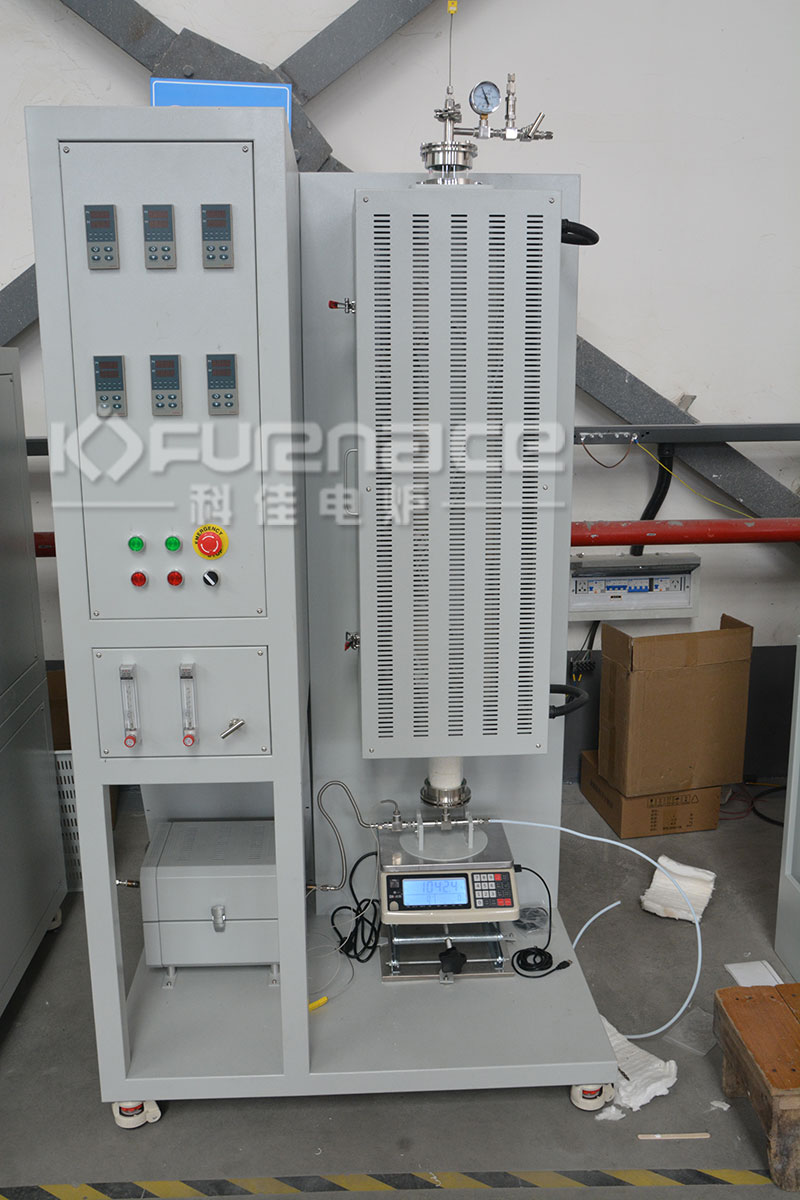
The vertical powder fluidized bed tube furnace is an experimental equipment that combines fluidized bed technology with the structure of a vertical tube furnace. It is suitable for uniform heating and efficient reaction of powder, granular or small block samples at high temperatures, and has a wide range of applications in materials science, chemistry, metallurgy and other fields. Let’s take a detailed look at this type of product below!
Working principle
Fluidized bed formation: Gas enters from the bottom of the furnace, is evenly distributed through the gas distribution plate, and then flows upward through the solid particle bed at a certain flow rate. When the gas flow rate reaches a critical value, the particle layer enters a fluidized state, exhibiting liquid like flow characteristics, with violent mixing between particles and suspension in the gas flow.
Enhanced heat transfer and reaction: In fluidized state, the gas and solid particles are in full contact, and the contact area is tens of times larger than that of a fixed bed, greatly enhancing heat conduction and chemical reaction rate. The vigorous movement of particles ensures uniform temperature distribution in the bed, with a temperature difference controlled within ± 5 ℃, while promoting diffusion of reactants and desorption of products.
Vertical tube structure: The furnace body adopts a vertical design, and the material is added from the top and falls down along the tube bundle, completing heating or reaction in the fluidized section, and finally discharged from the bottom. This structure utilizes gravity assisted material transportation to reduce the risk of blockage, while achieving uniform temperature distribution through optimized tube bundle layout. The vertical structure also facilitates gas flow control and reduces system resistance.
Multi parameter collaborative control: The gas flow rate (0-10L/min) can be adjusted through a mass flow meter, combined with real-time temperature data feedback from thermocouples, to achieve PID closed-loop control. The atmosphere composition is adjusted through a multi-channel gas switching system, which can simulate complex environments such as oxidation and reduction. The pressure control system maintains a slight positive pressure (0-0.02MPa) inside the furnace to prevent external pollution and ensure fluidization stability.
Structural advantage
Uniform heating: Fluidized bed technology ensures full contact between gas and solid particles, achieving uniform heating with a temperature difference controlled within ± 5 ℃.
High heat transfer efficiency: The contact area is tens of times larger than that of a fixed bed, which can greatly enhance heat conduction and chemical reaction rate.
Fast reaction speed: The vigorous movement of particles promotes the diffusion of reactants and the desorption of products, making it particularly suitable for multiphase catalytic reactions and powder material processing.
Small footprint: Vertical design saves space and facilitates laboratory or industrial site layout.
Easy to operate: By controlling parameters such as gas flow rate, temperature, and pressure, the process can be better controlled and processed.
Technical parameters (taking KJ-T1200-V100 model as an example)
Heating zone length: 900mm (can be customized according to customer needs)
Display mode: LED
Furnace material: alumina fiber
Heating element: alloy heating wire
Maximum heating temperature: 1200 ℃
Working temperature: ≤ 1100 ℃ (if metal cans are used in the furnace, please lower the temperature according to the actual situation)
Heating rate: ≤ 10 ℃/min
Heating zone: Three temperature zones (not separated) with independent temperature control for each zone (can be customized according to customer needs)
Heating zone length: 900mm (can be customized according to customer needs)
Furnace tube material: high-purity quartz tube
Furnace tube size: 80mm * approximately 1500mm (subject to actual supply). Customized perforated plates will be welded at appropriate positions in the furnace tube (can be customized according to customer needs)
Sealing method: A set of stainless steel vacuum flanges with sealing rings, equipped with mechanical pressure gauges, and reserved inlet and outlet ports.
The top is equipped with a quick connect flange and a thermocouple hole for measuring temperature inside the pipe
The bottom flange can be placed on an electronic scale to weigh furnace tubes, flanges, and materials inside the tubes
Equipped with an electronic differential pressure gauge, the pressure value between the top and bottom flanges can be measured, with a pressure difference range of ± 10Kpa
Install temperature measuring thermocouples and display instruments at the bottom and top air outlets of the flange
Control mode: Intelligent PID multi-stage program temperature control
Temperature curve: Multiple segments of “time temperature curve” can be set arbitrarily
Alarm: There is an alarm for over temperature and disconnection
Temperature measuring element: N-type thermocouple, equipped with an internal temperature measuring thermocouple
Weighing system: capable of real-time weighing of materials on and off the electronic scale
Gas preheating device: A gas preheating device is installed below the right side of the fluidized bed tube furnace, which can heat the gas and directly introduce it into the fluidized bed furnace
Float flowmeter: Two flow meters with a range of 0.6-6L/min are installed at the inlet end, and the gases are nitrogen and carbon dioxide
The intake volume can be manually adjusted according to the experimental process
Application field
In the field of chemical engineering, it is used for processes such as catalyst regeneration, drying, and calcination.
Metallurgical field: used for processes such as preheating and reduction of ores.
In the field of materials science, it is used for sintering and heat treatment processes of materials such as ceramics and glass.
CVD experiment: a CVD experiment specifically designed for powder surface deposition, in which sample particles are suspended in a heated area using a porous quartz plate for deposition experiments.
Key selection points
Temperature requirement: Select a tube furnace that can achieve the required temperature based on experimental or production needs. Generally speaking, its temperature range can range from a few hundred degrees Celsius to two thousand degrees Celsius.
Pipe diameter and length: Determine the appropriate pipe diameter and length according to actual needs to ensure the smooth progress of experiments or production. The diameter and length of the pipe directly affect its processing capacity and scope of application.
Heating zone length: The length of the heating zone determines its temperature uniformity and heating efficiency. A longer heating zone can provide a more uniform temperature field, suitable for experiments and production processes that require high temperature uniformity.
Temperature control accuracy: A high-precision temperature control system can ensure temperature stability during experiments or production processes, improving the reliability and reproducibility of experimental results.
Atmosphere control: Many experiments and production processes require specific atmospheric conditions to be carried out. Therefore, it is important to choose a tube furnace with good atmosphere control function. Common atmosphere control functions include vacuum, inert gas protection, etc.
Furnace tube material: The choice of furnace tube material directly affects its service life and performance. According to different usage needs, materials that are resistant to high temperatures, corrosion, and oxidation can be selected, such as quartz, corundum, metals, etc.
Safety performance: A good tube furnace should have comprehensive safety protection functions, such as over temperature alarm, leakage protection, emergency shutdown, etc., to ensure the safety of operators and equipment.
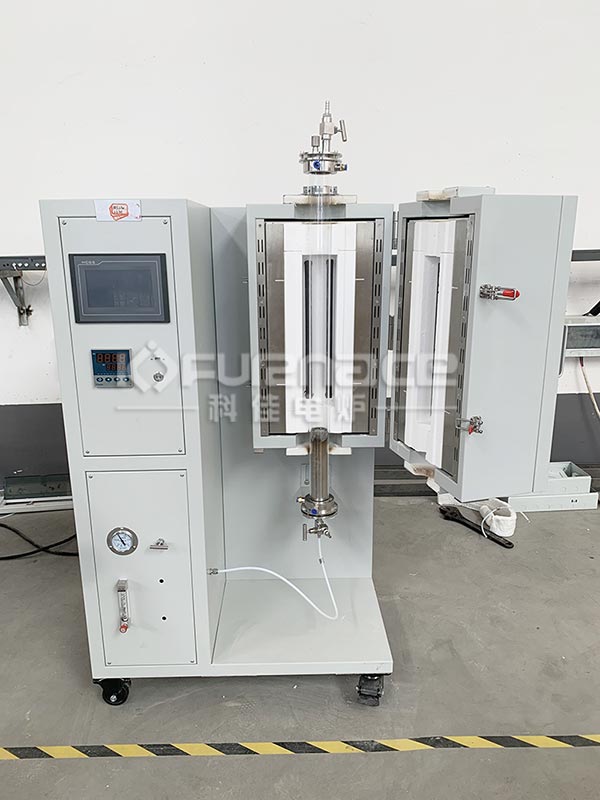
KJ-1100-V60 fluidized bed tube furnace (click on the picture to view product details)
Operation precautions
When the furnace temperature of the equipment is ≥ 200 ℃, it is forbidden to open the furnace to avoid injury.
When using the equipment, the pressure inside the furnace tube should not exceed 0.02MPa (micro positive pressure) to prevent equipment damage caused by excessive pressure.
When the temperature of the furnace body is higher than 1000 ℃, the furnace tube cannot be in a vacuum state. The pressure inside the furnace tube should be equivalent to atmospheric pressure and maintained at atmospheric pressure.
It is not recommended to close the exhaust valve and inlet valve at the flange end of the furnace tube when heating the sample. If it is necessary to close the gas valve to heat the sample, it is necessary to constantly monitor the reading on the pressure gauge. The absolute pressure gauge reading should not exceed 0.02 MPa, and the exhaust valve must be opened immediately to prevent accidents (such as furnace tube rupture, flange flying out, etc.).
When introducing gas into the furnace tube, a pressure reducing valve must be installed on the gas cylinder. It is recommended to use a pressure reducing valve with a pressure lower than 0.02 MPa to ensure safety.
The gas flow rate entering the furnace tube should be less than 200SCCM to avoid the impact of cold large airflow on the heated quartz tube.Click to learn more customized tube Furnaces! Or click on online customer service to learn more about product information!
Contact Information
E-mail: