English
 简体中文
简体中文 Français
 日本語
日本語 한국어
한국어 Português
 Русский
 Español




Tel Number
181-3719-5600
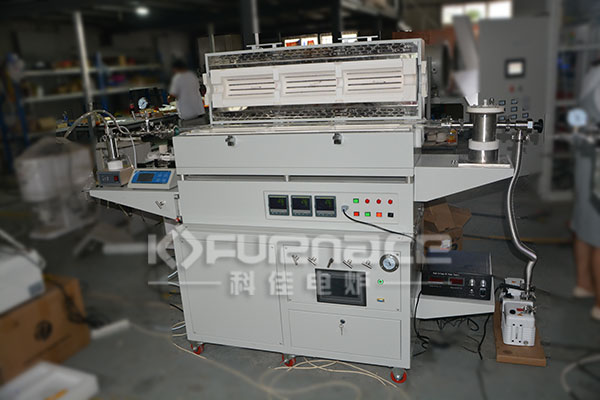
The 1.7Mhz ultrasonic atomization pyrolysis furnace is a multifunctional synthesis system designed for the composite coating process of synthesizing various nanostructured oxides and nanomaterials. The system consists of four main modules: aerosol generator, multi zone heating furnace, electrostatic precipitation (precipitation), and four channel mass flow controller. The material manufacturing process consists of three steps: precursor atomization, heating, and nanoparticle collection. This system is a very commonly used synthetic system, which can be widely used in the preparation of nanomaterials, electrode material coating and composite, and other fields. Let’s take a detailed look at this electric stove below!
1. Matching of core functional modules
Ultrasonic atomization device
Atomization frequency and particle size: High frequency atomizers (such as those above 1.7MHz) are preferred to produce finer droplets (particle size ≤ 5 microns), improving the uniformity of nanomaterial preparation. For example, Kejia furnace’s 1.7MHz ultrasonic atomizer supports dual modes of continuous atomization and conventional atomization, adapting to different process requirements.
Liquid compatibility: If dealing with high viscosity or corrosive liquids, it is necessary to confirm the atomizer material (such as 316 stainless steel tank body, titanium alloy microporous mesh) and sealing design (rubber sealing ring) to prevent leakage or corrosion.
Atomization control: Precise control of the amount is achieved through gear adjustment or liquid injection pump to avoid excessive atomization causing abnormal pressure inside the furnace.
heating system
Temperature range and uniformity: Select the rated temperature (such as 1200 ℃) based on the melting point of the material, and confirm the temperature uniformity inside the furnace (within ± 5 ℃). The three temperature zone design can independently control the temperature gradient in different areas, which is suitable for complex pyrolysis reactions (such as gradual decomposition of metal oxides).
Heating element and furnace tube material: Molybdenum containing resistance wire is suitable for scenarios below 1200 ℃, and silicon carbon rod can withstand high temperatures of 1400 ℃; High purity quartz furnace tubes are resistant to high temperatures and have strong chemical stability, reducing impurity pollution.
Heating rate and temperature control accuracy: Supports adjustable heating rate from 0-10 ℃/min, combined with 30 segment intelligent PID program temperature control to ensure process repeatability.
Gas and Vacuum Systems
Gas inlet function: If inert gas protection (such as argon or nitrogen) is required, choose a model equipped with a touch screen precision gas supply system that supports multiple gas source connections and precise flow control.
Vacuum system: The rotary vane pump and vacuum flange design can achieve vacuum and rapid gas replacement inside the pipe, preventing oxidation or volatilization. For example, the vacuum system of Kejia electric furnace supports real-time monitoring of the pressure inside the tube to avoid the risk of tube rupture.
Particle collection device
Collection efficiency and capacity: The high-voltage electrostatic collector adsorbs nanoparticles through the electric field between the positive and negative electrodes. It is recommended to slightly increase the effective volume of the collection cylinder to reduce frequent cleaning times.
Sealing and insulation design: quick connector+board insulation structure to prevent particle escape or short circuit, ensuring operational safety.
2. Prioritization of performance parameters
Temperature control: Temperature control accuracy (± 1 ℃)>Temperature uniformity>Maximum temperature (to meet material pyrolysis requirements).
Atomization effect: Atomization particle size>Atomization stability>Liquid compatibility.
Gas management: Vacuum limit>Gas flow accuracy>Gas source connection convenience.
Safety design: Over temperature alarm, pressure monitoring, and anti reflux devices (such as tilting furnace tubes) are essential functions.
3. Application scenario adaptability
Nanomaterial preparation: Choose a combination of a three temperature zone tube furnace and a high-frequency atomizer to support gradient pyrolysis of materials such as metal oxides and carbon nanotubes. For example, Kejia furnace’s 1200 ℃ three temperature zone model has a total length of 900mm (300mm × 3) and can achieve multi-stage reaction control.
Electrode material coating: A high-voltage electrostatic collection device is required to ensure efficient recovery of nanoparticles and uniform coating on the electrode surface.
Pilot production: Priority should be given to models that support 24-hour continuous liquid supply, combined with an automatic powder collection system to increase production capacity.
4. Brand and service considerations
Technical strength: Choose manufacturers that provide customized services (such as adjustable furnace size and number of temperature zones) to meet special process requirements. For example, Zhengzhou Kejia Electric Furnace supports customizing furnace tube materials (such as high-purity quartz, corundum) and heating element types according to customer needs.
After sales guarantee: Confirm the warranty period (and lifetime maintenance service), prioritize choosing manufacturers that provide free operation training and on-site maintenance.
User reputation: Referring to industry cases and third-party evaluations, prioritize brands with mature application experience in the field of nanomaterials.
5. Typical product recommendations
1200 ℃ Three Temperature Zone Ultrasonic Atomization Thermal Decomposition Furnace of Kejia Furnace
Core configuration: 1.7MHz ultrasonic atomizer, molybdenum resistance wire heating, high-purity quartz furnace tube, high-voltage electrostatic collector.
Advantages: Supports independent temperature control in three temperature zones (± 1 ℃), vacuum/gas dual-mode, RS485 communication interface, suitable for laboratory and pilot scenarios.
summary
When choosing an ultrasonic atomization pyrolysis furnace, priority should be given to matching core functional modules (such as high-frequency atomizers and three temperature zone heating systems), then selecting models based on performance parameters (temperature control accuracy, atomization particle size) and application scenarios (nano preparation, electrode coating), and finally determining the final solution based on brand services (customization, after-sales) and budget. For laboratory research, it is recommended to use Kejia furnace’s 1200 ℃ three temperature zone model.Click to learn more Customized Tube Furnaces! Or click on online customer service to learn more about product information!
Contact Information
E-mail: