English
 简体中文
简体中文 Français
 日本語
日本語 한국어
한국어 Português
 Русский
 Español




Tel Number
181-3719-5600
In the processes of lithium battery positive electrode (lithium iron phosphate/ternary), negative electrode (graphite/silicon carbon), and recycling black powder, the rotary tube furnace has become the core equipment for powder heat treatment due to its advantages of dynamic rolling, uniform heating, and controllable atmosphere. When selecting, the speed, atmosphere, and temperature zone directly determine material consistency, production capacity, and energy consumption. Choosing the wrong parameters can easily lead to problems such as uneven carbon coating, crystal defects, and excessive impurities. Below, based on the three core dimensions and the process characteristics of battery materials, practical selection criteria and parameter ranges are provided to help you better match equipment requirements.
1. Speed selection: determines the uniformity of material mixing and residence time
The rotating tube furnace continuously rolls the animal material through the rotation of the furnace tube, and the rotational speed directly affects the mixing efficiency, heating uniformity, and axial movement speed of the material, which is the core parameter to avoid local overburning and raw burning.
(1). The core influence of rotational speed on battery materials
Low rotational speed (<2rpm): Insufficient material rolling, easy accumulation and agglomeration, local overburning, uneven carbon coating (lithium iron phosphate), insufficient lithium source diffusion (ternary), and other problems directly reduce the electrochemical performance of the material. High rotational speed (>8rpm): The powder adheres to the furnace wall due to centrifugal force, reducing the effective heating area and causing severe dust. At the same time, the residence time of the material is shortened and the reaction is insufficient; High nickel ternary materials may also suffer structural damage due to particle impact.
Speed adaptation range: universal 2-5 rpm for battery materials (powder/small particles); The preferred coating for lithium iron phosphate carbon is 3rpm, which balances mixing and coating uniformity; Choose 2-4 rpm for ternary materials (especially high nickel) to prevent particle breakage.
(2). Key parameters for speed selection
Variable frequency speed regulation: Priority should be given to the 0-10rpm stepless variable frequency model, which can be flexibly adjusted according to material particle size and filling rate; Laboratory grade options include 0-7rpm, while industrial grade (continuous) recommends 0-15rpm.
Tilt angle and rotation speed coordination: The inclination angle of the furnace tube is 1-5 ° (commonly 3 °). The larger the inclination angle, the faster the axial flow velocity of the material, and it is necessary to cooperate to reduce the rotation speed and extend the residence time; On the contrary, increase the speed to ensure that the residence time meets the standard (lithium iron phosphate insulation for 5 hours, ternary insulation for 4-6 hours).
Filling rate matching: Furnace tube filling rate ≤ 30% (recommended 15-20% for battery materials). When the filling rate is high, reduce the speed by 1-2rpm to avoid material accumulation.
2. Atmosphere selection: Control material purity and crystal stability
Battery materials are sensitive to oxygen and moisture, and the atmosphere system directly determines whether the material oxidizes, the level of impurities, and the integrity of the crystal structure. It is the core guarantee for lithium iron phosphate oxidation prevention and ternary lithium reaction promotion.
(1). Atmosphere requirements for different battery materials
Lithium iron phosphate (LFP): The core requirement is to prevent Fe ² ⁺ oxidation, which must be carried out in an inert atmosphere of high-purity nitrogen (N ₂) or argon (Ar) with an oxygen content of ≤ 100ppm; Air is strictly prohibited from entering, otherwise Fe ³ ⁺ will be generated, causing a sudden drop in material capacity.
Ternary materials (NCM/NCA): require weak oxidation/pure oxygen atmosphere (O ₂ content 5-21%) to promote the reaction between lithium source and transition metal oxide, and improve crystallinity; High nickel ternary (NCM811) requires a mixture of low oxygen and high-purity nitrogen to prevent lithium deposition at high temperatures.
Negative electrode material (graphite/silicon carbon): N ₂/H ₂ mixed gas (5-10% H ₂) is used for graphite coating to promote carbon source cracking and deposition; Silicon carbon materials require a high-purity Ar atmosphere to prevent silicon oxidation and volume expansion cracking.
Recycling of black powder: During the pyrolysis stage, the binder is removed using an N ₂ inert atmosphere; During the roasting stage, a weak oxidizing atmosphere is used for ternary black powder, while an inert atmosphere is used to prevent oxidation of lithium iron phosphate black powder.
(2). Core points for selecting atmosphere system
Sealing performance priority: Stainless steel flanges and sealing rings are used at both ends of the furnace tube, with a vacuum degree of ≤ 10Pa to prevent air infiltration; Industrial grade oxygen content online monitoring device with real-time linked air supply system.
Gas source and flow matching: 99.99% high-purity N ₂/Ar is selected for inert atmosphere, with flow rates of 0.5-2L/min (laboratory) and 5-20L/min (industrial); To restore the atmosphere, an explosion-proof system (flame sensor+explosion-proof valve) is required to eliminate safety hazards.
Vacuum assisted optional: For materials with high purity requirements (such as battery grade lithium iron phosphate), a vacuum+atmosphere composite system is selected. First, evacuate (≤ 10 ⁻ Pa) and then pass protective gas to completely remove air and moisture.
3. Temperature zone selection: ensuring temperature field uniformity and process adaptability
The number, length, and temperature control accuracy of temperature zones directly determine the uniformity of temperature inside the furnace, which in turn affects the consistency of material crystal structure, production capacity, and energy consumption; The narrow sintering temperature window and uneven temperature field of battery materials can easily lead to batch scrap.
(1). Selection of temperature zone quantity: match according to production capacity and material type
Single temperature zone (laboratory/small trial): The length of the constant temperature zone is 200-300mm, with a temperature control accuracy of ± 1 ℃, suitable for small batch experiments of 1-5kg/batch (such as formula development and process exploration); Only applicable to lithium iron phosphate/ordinary ternary small samples, not suitable for industrial production.
Three temperature zones (pilot/small batch production): divided into preheating zone, constant temperature zone, and cooling zone, with a constant temperature zone length of 600-1000mm, temperature field uniformity of ± 5 ℃, suitable for 50-200kg/day production capacity; It is the mainstream choice for pilot and small-scale production of lithium iron phosphate, which can eliminate end heat loss and extend the effective temperature equalization zone.
Multi temperature zone (industrial continuity): 4-6 temperature zones, constant temperature zone length ≥ 1500mm, temperature field uniformity ± 5 ℃, suitable for 1-5 tons/day production capacity; High nickel ternary materials must be selected in multiple temperature zones to ensure a temperature difference within ± 5 ℃ and prevent component segregation and capacity decay.
(2). Temperature parameter selection: match more accurately according to the sintering window of the material
Lithium iron phosphate: sintering temperature 700-750 ℃, long-term working temperature ≤ 850 ℃; The heating rate is 5 ℃/min to avoid powder agglomeration caused by too fast a rate; A temperature field uniformity of ± 5 ℃ is sufficient to meet the requirements.
Ternary materials: Conventional ternary (NCM111/523) 800-900 ℃, high nickel ternary (NCM811) 850-950 ℃; The heating rate is 3-5 ℃/min, and the temperature field uniformity is ± 5 ℃. Excessive temperature difference can lead to lithium volatilization and crystal defects.
Recycling of black powder: pyrolysis temperature 450-550 ℃ (oxygen free), calcination temperature 550-650 ℃, temperature field uniformity ± 5 ℃, suitable for black powder decarbonization and crystal shape adjustment needs.
(3). Selection of Heating Elements and Temperature Control Systems
Heating element: Select silicon carbon rod for ≤ 1200 ℃, silicon molybdenum rod for 1200-1700 ℃ (U-shaped surround heating, uniform temperature field); It is strictly prohibited to use resistance wires, as they are prone to oxidation and fracture at high temperatures.
Temperature control system: Equipped with 30 segment PID program temperature control, it can store multiple sintering curves and adapt to different material processes; Supports USB/Wi Fi data recording for easy production traceability and process optimization.
4. Summary of Selection of Rotating Tube Furnace for Battery Materials (Core Parameter Table)
| Selection dimension | Key Parameters | Lithium Iron Phosphate (LFP) | Three element material (NCM) | Recycling black powder for regeneration |
| Speed | Recommended range | 2– 5rpm (preferably 3rpm) | 2– 4 rpm (high nickel 2‐); 3rpm) | 3– 5rpm |
| Atmosphere | Type | High purity N ₂/Ar (oxygen≤ 100ppm) | O ₂/N ₂ mixture (oxygen 5–); 21%) | Pyrolysis of N ₂, calcination as needed |
| Temperature zone | Quantity | Three temperature zone (pilot)/multi temperature zone (industrial) | Multi temperature zone (≥ 4 temperature zones) | Three temperature zones |
| Temperature zone | Temperature | 700– 750℃(±5℃) | 800– 950℃(±5℃) | Pyrolysis 450– 550℃ |
| Capacity | Adaptation scale | 50kg– 1 ton/day | 50kg– 1 ton/day | 50kg– 1 ton/day |
5. Selection avoidance and industry trends
(1). Common points for avoiding pitfalls
Only focus on the highest temperature and ignore the long-term working temperature: Silicon molybdenum rods are prone to aging if they exceed 1500 ℃ for a long time, while lithium iron phosphate should choose models with long-term ≤ 850 ℃ and ternary ≤ 1000 ℃.
Neglecting furnace tube material: 310S stainless steel tube is used for temperatures ≤ 1000 ℃, high-purity corundum tube is used for temperatures 1000-1600 ℃; It is strictly prohibited to use ordinary steel pipes for ternary materials to prevent contamination by iron impurities.
Blindly pursuing high speed: High speed is prone to dust and reduces residence time. Battery materials should prioritize medium and low speeds with a reasonable inclination angle combination.
(2). industry trends
Low temperature+precise temperature control: reduces energy consumption, improves lithium recovery rate, and adapts to the recycling and regeneration needs of lithium iron phosphate.
Atmosphere speed temperature zone linkage: The intelligent control system achieves automatic parameter matching, reduces manual intervention, and improves product consistency.
Large scale+continuous: The single line production capacity reaches one year per year, which is suitable for the large-scale production and recycling market demand of power battery materials.
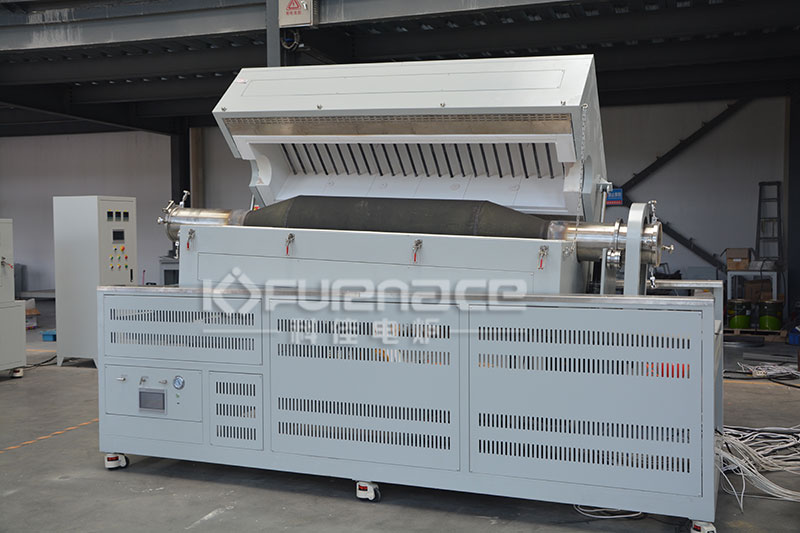
Large scale tube rotary kiln (click on the image to view product details)
Conclusion
The selection of battery material rotary tube furnace depends on the mixing and retention speed, purity and crystal structure of the atmosphere, and uniformity and production capacity of the temperature zone. These three dimensions are interrelated and directly affect product quality and production costs. When selecting a company, it is necessary to consider its own material type (lithium iron phosphate/ternary/recycled black powder), production capacity, and process requirements, prioritize matching core parameters, and also consider equipment stability, energy consumption, and cost-effectiveness. More accurate selection is necessary to fully leverage the advantages of dynamic heat treatment in rotary tube furnaces, which can help upgrade the performance of battery materials and reduce costs and increase efficiency in the industry.Click to learn more customized tube furnaces! Or click on online customer service to learn more about product information!
Contact Information
E-mail: