English
 简体中文
简体中文 Français
 日本語
日本語 한국어
한국어 Português
 Русский
 Español




Tel Number
181-3719-5600
In the fields of lithium battery materials, carbon nanomaterials, powder metallurgy, catalytic powders, and advanced ceramic sintering, multi temperature zone rotary tube furnaces gradually replace traditional single temperature zone fixed tube furnaces with their three core advantages of segmented gradient temperature control, dynamic rolling heating of materials, and continuous heat treatment. Many procurement personnel often struggle with how to match the number of temperature zones, set the speed range, and determine the appropriate tilt angle when selecting for the first time. Choosing the wrong parameters can not only cause uneven sintering of materials and a decrease in the yield of finished products, but also prolong the process cycle and increase energy consumption costs.
Below, we will combine the new material heat treatment process scenario and break down the three core parameters of temperature zone quantity, rotation speed, and tilt angle one by one. We will also provide a comparison table for different material selection and key points for avoiding pitfalls during selection. The entire text is easy to understand and can be directly selected according to the needs to adapt to the machine model. It is suitable for laboratory research and development, pilot scale, and small-scale continuous production users to refer to.
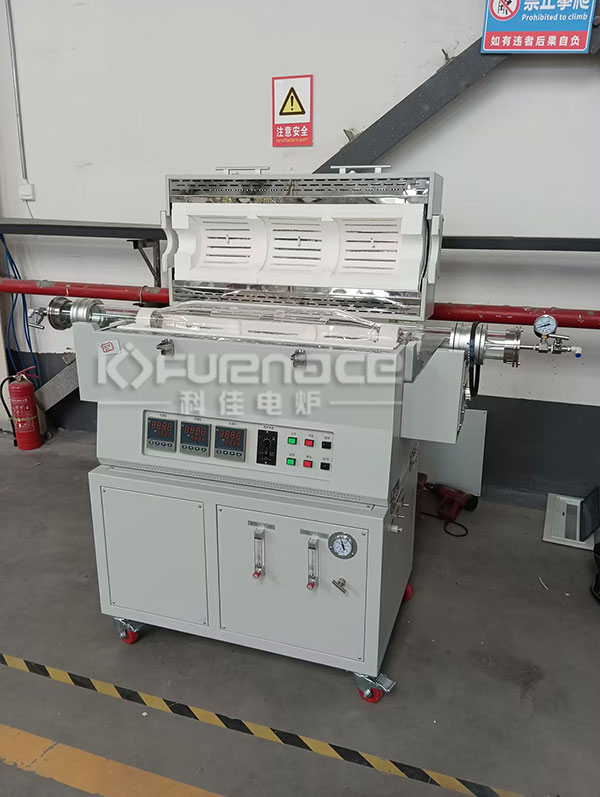
Customized vacuum rotary tube furnace (click on the image to view product details)
1. Core parameter 1: Selection of number of temperature zones (2 zones/3 zones/multi zone differences and applicable scenarios)
A multi temperature zone rotary tube furnace refers to a furnace that is divided into multiple independent heating zones, each equipped with an independent PID temperature control module. The heating, insulation, and cooling curves can be set separately to create a gradient temperature field for the preheating section, high-temperature sintering section, and slow cooling section, which is the key to distinguishing it from ordinary rotary tube furnaces. The mainstream on the market is divided into three categories: dual temperature zone, triple temperature zone, and four to eight temperature zone. You can choose according to your needs.
(1) Dual temperature zone rotary tube furnace (entry-level cost-effective model)
Structural configuration: The furnace is divided into 2 independent temperature control sections, with a total heating length of 400mm~1200mm, starting from a single temperature zone length of 200mm, and a temperature control accuracy of ± 1 ℃
Advantages: Moderate price, simple structure, low failure rate, and low maintenance cost in the later stage; Two stages of heating and preheating in the front stage and constant temperature sintering in the back stage can be set up to meet the basic two-stage heat treatment requirements
Adaptation scenario:
Conventional powder calcination, metal powder annealing, and simple catalyst activation in university laboratories;
Due to limited budget, the process only requires two stages of heating and constant temperature;
Small batch intermittent production without strict gradient cooling requirements
Shortcoming: Unable to achieve a complete three-stage process of preheating, high temperature sintering, and slow cooling, low upper limit of temperature field adjustment, and high value-added precision materials are not recommended for use
(2) Three temperature zone rotary tube furnace (industry standard mainstream model, commonly used by 90% of new material customers)
The three-stage temperature zone is currently a standard selection for lithium-ion cathode materials, carbon materials, and molecular sieve sintering. The three-stage temperature zone can better correspond to the complete heat treatment process flow:
Zone 1 (preheating zone): low-temperature dehydration and removal of organic impurities from powder → Zone 2 (constant temperature sintering zone): core high-temperature crystallization and solid-state reaction → Zone 3 (slow cooling zone): gradient slow cooling to prevent powder rapid cooling cracking and grain distortion
Performance highlights: The overall average temperature zone is longer, and the heat loss at the ends is offset by the temperature zones at both ends. The temperature difference in the central constant temperature section of the furnace can be controlled within ± 3-5 ℃; More than 30 programmable temperature control curves per zone, capable of storing multiple sets of process parameters and allowing for one click access to production
Adaptation scenarios: Continuous sintering of precision powders such as lithium iron phosphate, ternary lithium battery materials, graphene, carbon nanotubes, alumina ceramic powder, rare earth fluorescent powder, etc; Pilot production line, new material formula development iteration scenario
Applicable temperature: 1200 ℃/1400 ℃/1600 ℃ High temperature models can be equipped with a three temperature zone structure
(3) Four temperature zones and above with multiple temperature zones (customized models)
The temperature zones 4-8 belong to deep customized equipment, with more detailed temperature field division. They are mostly used for ultra long furnaces, ultra long material residence times, and multi-step continuous chemical reaction processes, such as powder CVD vapor deposition, multi-stage coating modification, and long process reduction carbonization processes.
Application: Industrial continuous rotary pilot line, customized synthesis of special nanomaterials; Conventional laboratories and small and medium-sized pilot projects do not need to be blindly selected, as they will significantly increase procurement costs and energy consumption
Quick selection formula for temperature zone quantity
Simple process, limited budget → Dual temperature zone;
Precision sintering and universal pilot testing of lithium/carbon materials → three temperature zones;
Ultra long process gas-phase deposition, industrial long-term production → customized for 4 zones and above.
2. Core parameter 2: How to adjust the rotational speed? Guidelines for different material speed ranges
Rotation is the core function of a rotary tube furnace: the furnace tube rotates at a constant speed with the animal material continuously rolling and lifting, breaking the temperature difference caused by static powder accumulation, allowing each particle to be heated and in contact with the same atmosphere, and eliminating problems such as agglomeration, entrapment, and overburning. The equipment adopts variable frequency stepless speed regulation, with a conventional adjustable range of 0-30r/min, and the speed varies greatly depending on the material.
(1) Low speed range: 1~5r/min (for ultra-fine and easily damaged powders)
Applicable materials: nano powder, ultra-fine oxide powder, graphene, carbon nanotubes, fragile molecular sieve carrier, soft lithium anode material
Reason for selection:
Excessive rotational speed can cause particles to collide and break, damaging the original grain morphology; Low speed gentle rolling can ensure uniform heating and protect the complete morphology of the powder; Suitable for vacuum sintering, inert atmosphere static insulation process.
⚠️ Attention: Pure static insulation can be set to 0-turn intermittent start stop mode, and the material can be flipped at a fixed time
(2) Medium speed range: 6-15 r/min (the general standard speed for most granular powders)
Mainstream applications: lithium iron phosphate, ternary cathode materials, granulated ceramic powder, metal alloy powder, catalyst particles
Process advantages: Moderate rolling force, higher gas-solid exchange efficiency, and rapid precipitation of impurities and gases inside the powder; When used with a tilt angle, it can more accurately control the speed of material movement and is a standard speed range for continuous production.
(3) High speed section: 16~30r/min (large particles, block materials, drying and impurity removal process)
Applicable: Large particle ceramic aggregates, coarse metal particles, pre drying and dehydration of materials, rapid cracking and removal of organic matter;
Advantages: The material flips violently, the heat transfer efficiency is maximized, and the drying and pretreatment time is significantly shortened; Disadvantages: Fine powder is easy to raise dust, which is not suitable for long-term high-speed operation of ultra-fine nano powder.
Selection details for speed matching
Prioritize servo variable frequency motor+overload protection structure: automatic shutdown alarm for material blockage to avoid damage to furnace tubes and transmission structures;
Supporting forward and intermittent forward and reverse rotation functions is better, which can further improve the uniformity of powder mixing;
In high-temperature and vacuum environments, it is necessary to use a magnetic fluid dynamic sealing rotating structure to ensure that there is no air leakage or pressure relief during the rotation process.
3. Core parameter three: Tilt angle selection (0 °~30 ° tilt angle effect+scene division)
The overall tilt angle of the machine is a key parameter for controlling the residence time of materials in the furnace and the feeding and discharging methods. It is divided into two types: manual tilt angle adjustment and electric infinite tilt angle adjustment. The industry standard adjustable range is 0 °~30 °, and customized models can reach 0 °~45 °. The smaller the inclination angle, the longer the material residence time; The larger the inclination angle, the faster the material slides down and the higher the single processing output. Combined with speed coordinated control, it is the core logic of continuous production.
(1) 0 ° horizontal placement: intermittent batch sintering main push
The furnace body is completely horizontal, and the material will only roll in place with the furnace tube and will not move towards the discharge end. The entire process is enclosed, insulated, and sintered.
Applicable scenarios:
① Long term constant temperature solid-state reaction and crystal growth process are required;
② Small batch laboratory sampling and formula comparison testing;
③ Vacuum sealed sintering and firing of valuable powder that is prone to loss.
Advantages: No material loss, more complete reaction; Disadvantage: Unable to automatically feed in and out continuously, manual material pouring is required after sintering is completed.
(2) 1 °~5 ° micro tilt: precision powder continuous sintering mainstream tilt angle (standard for three temperature zones)
The most commonly used process inclination angle, combined with a standard speed of 6-12r/min, allows the material to slowly and uniformly slide forward, with a controllable residence time of 1-6 hours, better matching the segmented sintering cycle of lithium battery materials and carbon materials.
Advantages: Smooth travel speed, no incomplete sintering caused by too fast flow rate; It can achieve continuous feeding and discharging, 24-hour uninterrupted production, stable output, better consistency of finished products, and is also a common inclination angle setting for major new material pilot lines.
(3) 6 °~15 ° Medium Tilt Angle: High Capacity Pre treatment and Baking Process
Commonly used in the pre drying, decarbonization, and low-temperature roasting processes of powders, it has fast material movement speed, large processing capacity per hour, and shortened pretreatment time; Not recommended for use in the core high-temperature crystallization stage, as insufficient residence time can easily lead to under burning defects.
(4) 15 °~30 ° large inclination angle: fast unloading, processing of coarse particle materials
Two major uses:
After sintering, adjust the base note high inclination angle, rotate the furnace tube to drain the internal materials quickly, discharge the materials conveniently, and reduce the waste of powder residue;
Heat treatment of high-density materials such as sand and gravel, coarse ceramic particles, etc., relying on gravity to quickly pass through the furnace.
⚠️ Taboo: Ultra fine powder should not be operated at a large angle for a long time, as it is prone to problems such as uncontrolled powder flow rate and insufficient sintering time.
Tips for Choosing a Tilt Angle
Most of the research and development samples are made: the player’s tilt angle adjustment provides higher cost-effectiveness;
Continuous production throughout the day: priority electric infinite tilt angle adjustment, touch screen one click angle setting, automatic locking, easy operation.
4. Selection of key supporting accessories (parameter matching must be considered to determine the overall practicality of the equipment)
After selecting the three major parameters of temperature zone, speed, and inclination angle, it is necessary to match the auxiliary configuration according to the process requirements to avoid parameter adaptation but inability to meet the working conditions:
Furnace tube material
≤ 1000 ℃: 310S stainless steel furnace tube, resistant to atmosphere, low cost, capable of vacuum pumping, low cost of replacing furnace tube, can be used as irregular tube, such as large belly tube, etc;
≤ 1200 ℃: High purity quartz tube, commonly used, can observe the sintering situation of the furnace, can pass the atmosphere and be evacuated, with a wide range of applications;
1200~1600 ℃: High purity corundum furnace tube, resistant to high temperatures without impurity precipitation, mainly recommended for lithium batteries and high-purity materials;
Atmosphere and vacuum system: Selective gas control cabinet for reducing and inert sintering; Highly oxidizable powders require a high vacuum unit to be installed;
Furnace insulation: 1700 grade alumina fiber insulation layer, with low heat storage, fast heating, and better energy-saving effect;
Safety protection: a complete set of safety systems including over temperature power-off, couple breaking protection, air pressure interlock, and rotation overload shutdown, which are commonly used in high-temperature production.
5. Summary Table of Complete Parameter Selection for Materials in Different Industries
| Application Industry | Recommended temperature range | Adapt speed | Common tilt angles | Core process requirements |
| Lithium battery positive and negative electrode materials | Three temperature zones | 5~12r/min | 2° ~4° | Gradient sintering, continuous production, uniform grain size |
| Graphene/carbon nanotubes | Three temperature zones | 2~6r/min | 1° ~3° | Low speed anti damage, atmosphere CVD deposition |
| Catalytic molecular sieve | Dual/triple temperature zone | 4~10r/min | 0° ~5° | Activation roasting, intermittent+continuous dual-use |
| Metal Powder Metallurgy | Dual temperature zone | 8~18r/min | 3° ~8° | Reduction annealing, removal of oxide impurities |
| Alumina/zirconia ceramic powder | Three temperature zones | 6~15r/min | 2° ~6° | High temperature solid-phase synthesis, no agglomeration |
| Laboratory formula development | Dual temperature zone | Adjustable from 1 to 10r/min | 0° ~6° Manual tilt angle | Multi formula comparison and flexible process modification |
6. Summary of Choosing Avoidance Pits
Don’t blindly pursue multiple temperature zones: conventional powder sintering with three temperature zones is completely sufficient, and excess temperature zones will only increase procurement and electricity costs;
The faster the speed, the better: Low speed is preferred for ultrafine powders, while also considering morphology integrity;
Tilt angle and rotational speed must be adjusted together: both determine the material residence time, and adjusting a single parameter cannot guarantee process stability;
Continuous production must choose an electric tilt angle+servo variable frequency rotation system for stronger long-term stability.
The core selection logic of multi temperature zone rotary tube furnace is always based on its own heat treatment process, reverse matching of temperature field, rolling speed, material residence time, and parameter matching process, in order to maximize the yield of finished products and reduce production costs.Click to learn more customized tube furnaces! Or click on online customer service to learn more about product information!
Contact Information
E-mail: