English
 简体中文
简体中文 Français
 日本語
日本語 한국어
한국어 Português
 Русский
 Español




Tel Number
181-3719-5600
In the powder new material preparation industry, ordinary fixed tube furnaces often encounter problems such as material accumulation and agglomeration, large heating temperature differences, incomplete solid-phase reactions, and uneven product quality. The 1200 degree rotary tube furnace relies on the uniform rolling of materials in the furnace tube to achieve dynamic sintering of powders. It is divided into two working modes: intermittent sample sintering and continuous feeding and discharging large-scale heat treatment. Nowadays, it has become the mainstream heat treatment equipment in university material laboratories, catalyst processing plants, lithium battery powder factories, and advanced ceramic production enterprises.
When many new material practitioners first purchase equipment, they are not clear about which processes the 1200 ℃ rotary tube furnace is suitable for, what materials it can process, and what advantages it has compared to ordinary tube furnaces. Below is a comprehensive explanation of the working principle, core advantages, segmented processes, industry wide applications, and key purchasing points of this powder specific electric furnace, to help researchers and factory procurement quickly understand it.
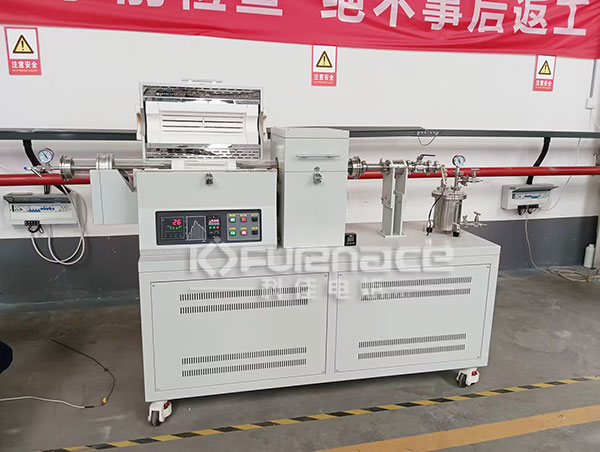
A commonly used 1200 degree rotary tube furnace (click on the image to view product details)
1. What is a 1200 degree rotary tube furnace and what is its working principle?
The maximum working temperature of the 1200 degree rotary tube furnace can reach 1200 ℃. The core structure includes a heating furnace, rotatable tilting quartz/corundum furnace tubes, multi-stage program temperature control system, and atmosphere inlet sealing components. The continuous model is also equipped with automatic feeding and discharging collection mechanisms.
The key difference between it and a regular static tube furnace is that the furnace tube can rotate at a uniform speed of 360 °, and the powder and granular raw materials inside the tube keep flipping, rolling, and mixing; The furnace body supports a tilt angle of 0-20 °, which controls the material’s forward speed and the duration of stay inside the furnace based on the tilt angle.
Intermittent type: After loading materials, the furnace is sealed and the entire process of heating, insulation, and cooling is completed before unloading. The main focus is on formula debugging and small batch testing;
Continuous: The powder is continuously fed from the feeding end and passes through the heating zone, high-temperature sintering zone, and cooling zone in sequence during the rolling process. The finished product is continuously discharged, achieving uninterrupted powder continuous heat treatment.
The material is in a dynamic rolling state and will not accumulate at the bottom of the furnace. Each powder particle alternately contacts the heating surface of the high-temperature furnace tube, completely avoiding common problems such as local overheating, sintering agglomeration, and incomplete reaction, which is known as the dynamic sintering process in the industry. The equipment can also be filled with various atmospheres such as nitrogen, argon, hydrogen, and air to complete oxidation, reduction, and inert protection sintering operations.
2. Five core advantages of powder dynamic sintering compared to static heating
(1). Uniformly heated, the powder is not easily agglomerated or clumped
During static sintering, the powder accumulates and stands still, causing the bottom material to be compressed and have poor air permeability, making it prone to adhesion and agglomeration at high temperatures. The rotary tube furnace continuously flips the material, causing particles to roll and rub against each other. The temperature difference during heating can be controlled within 5 ℃. After sintering, the powder becomes loose, and most working conditions do not require subsequent crushing processes.
(2). Accelerate gas-solid reaction and make sintering reaction more complete
During calcination, precursor decomposition, and solid-phase synthesis, a large amount of volatile gases are generated; The material constantly flips, and the internal decomposed gas can quickly overflow. The atmosphere gas can fully contact the surface of the powder, improving the conversion rate of solid-phase reactions, which is very suitable for catalysts and metal oxide reduction processes.
(3). Adjustable process parameters, suitable for various powder raw materials
The furnace tube speed, inclination angle, heating curve, insulation duration, and atmosphere flow rate can all be freely set. Increase the rotational speed of powders with poor fluidity and easy wall sticking; To reduce the inclination angle of the furnace tube and adapt to powders, particles, and small block materials, it is necessary to extend the sintering time.
(4). Support continuous production, stable mass production quality
The continuous feeding and discharging version can operate 24/7 without interruption, and all powders have a uniform residence time in the high-temperature zone. Under large-scale production, the crystal phase structure, specific surface area, and pore size structure of each batch of secondary powders remain consistent, and the product repeatability far exceeds that of batch type box furnaces and ordinary tube furnaces.
(5). Complete temperature control and safety, suitable for complex heating programs
Equipped with PID intelligent temperature control, supporting more than 30 stages of temperature rise and fall program settings, equipped with over temperature alarm, thermocouple disconnection protection, overcurrent leakage protection, and cover opening power-off protection; The furnace tube is made of high-purity quartz tube or corundum tube, which is resistant to acid and alkali corrosion and suitable for most inorganic powder heat treatment processing.
3. Detailed explanation of the mainstream process of 1200 ℃ rotary tube furnace
(1). Powder dynamic sintering
This equipment is also mainly used for high-temperature solid-state synthesis of ceramic powder, lithium battery raw materials, and magnetic powder, relying on rolling to achieve uniform sintering and prevent over burning and under burning.
(2). Precursor calcination and thermal decomposition
Oxalate, carbonate and hydroxide precursors are decomposed at high temperature to remove crystal water and volatile impurities and prepare nano powder and oxide powder.
(3). Catalyst activation and calcination
Molecular sieves, alumina carriers, denitrification catalysts, and photocatalytic materials are activated by high-temperature calcination to more accurately control the specific surface area and pore structure of the carriers.
(4). Powder reduction heat treatment
Introduce hydrogen and ammonia decomposition atmosphere to complete the reduction of metal oxide powder, and prepare high-purity alloy powder and metal ultrafine powder.
(5). Powder coating modification
The surface of the particles is coated with carbon and oxide, resulting in a more uniform coating layer under rolling conditions. It is commonly used for lithium battery negative electrodes and conductive powder modification.
(6). Activation processing of non-metallic minerals
High temperature activation, purification, and modification processing of kaolin, bentonite, diatomaceous earth, and mineral powder.
4. Comprehensive application review of major industries
(1) New Energy Lithium Battery Materials Industry
Suitable for lithium iron phosphate, ternary positive electrode, lithium manganese oxide, graphite negative electrode, silicon carbon composite material, and solid electrolyte powder heat treatment.
The temperature window for lithium battery coating sintering is very narrow, and a temperature difference of ± 5 ℃ can cause defects in the coating layer; Dynamic rolling sintering can stably control the surface carbonization quality of particles, improve the yield of battery materials, and is a standard equipment for the research and development and pilot production of lithium battery new materials.
(2) Advanced Electronic Ceramic Powder Industry
Pre sintering of barium titanate, zirconia, alumina, piezoelectric ceramics, and thermistor powders. Dynamic sintering can ensure the uniform generation of powder crystal phases, reduce powder hard agglomeration, and lower the burden of subsequent ball milling processes.
(3) In the field of chemical catalysts and adsorption materials
Petrochemical catalysts, waste gas treatment catalysts, molecular sieves, activated carbon modification, and high-temperature calcination activation of adsorbents.
The pore structure of the catalyst directly determines its catalytic performance. A 1200 degree rotating tube furnace temperature and uniform heating conditions can avoid pore collapse caused by local high temperatures on the carrier.
(4) Powder metallurgy, high-purity metal powder
Calcination, reduction, and alloying treatment of copper powder, nickel powder, iron-based alloy powder, and rare earth oxide powder; Low oxygen content ultrafine metal powder can be prepared under a reducing atmosphere.
(5) University laboratories and research institutes
The School of Materials Science, School of Chemical Engineering, and Rare Earth Research Institute are used to explore new material formulas and conduct control sample experiments; Intermittent models can adjust multiple heating rates and atmosphere conditions within a day, quickly screening for better preparation processes.
(6) Processing of inorganic non-metallic minerals
High temperature purification, activation, and modification of kaolin, mica, bentonite, and quartz powder are commonly used in the pre-treatment process of ceramic raw materials and filler materials.
5. How to choose between intermittent and continuous
Choose intermittent rotary tube furnace: university research and development, multiple formula sample making, small batch customized powder, process parameters not yet finalized, frequent replacement of processing materials required.
Choose a continuous feeding and discharging rotary tube furnace: mature formula, large-scale powder production, need to save labor, access to powder automation production line, long-term fixed production of 1-3 types of finished powder.
6. Practical considerations for equipment selection
Selection of furnace tube material: Quartz tubes are used for temperatures below 1000 ℃; Frequent use of hydrogen and strong alkali powder is preferred for corundum alumina furnace tubes to avoid corrosion and loss of quartz tubes;
Atmosphere sealing structure: Vacuum and reducing atmosphere sintering are required, and a rotating sealing flange is selected to prevent air leakage during the rotation of the furnace tube;
Speed and inclination range: The speed of scientific research equipment can be infinitely adjusted from 0 to 20r/min; For powders that are prone to sticking to walls and clumping, it is recommended to choose furnace tubes with internal flipping baffles;
Temperature control configuration: The R&D model uses a multi-stage programmed heating instrument; Industrial continuous furnaces prioritize independent temperature control structures in multiple temperature zones, with separate temperature control for the heating section, insulation sintering section, and cooling section.
Summary
Simply put, the 1200 degree rotary tube furnace is a dynamic heat treatment electric furnace specifically designed to solve the problems of uneven heating and sintering agglomeration of powders. By relying on furnace tube rolling to achieve dynamic sintering of powders, calcination, decomposition, solid-phase synthesis, reduction, and powder coating modification processes can be completed, covering many fields such as lithium battery materials, advanced ceramics, catalysts, metal powders, and university research.
Intermittent models are selected for research and development samples, while continuous feeding and discharging models are used for mature powder mass production. By combining powder characteristics, atmosphere environment, and maximum process temperature, suitable specifications of rotary tube furnaces can be matched.Click to learn more tube furnaces! Or click on online customer service to learn more about product information!
Contact Information
E-mail: