English
 简体中文
简体中文 Français
 日本語
日本語 한국어
한국어 Português
 Русский
 Español




Tel Number
181-3719-5600
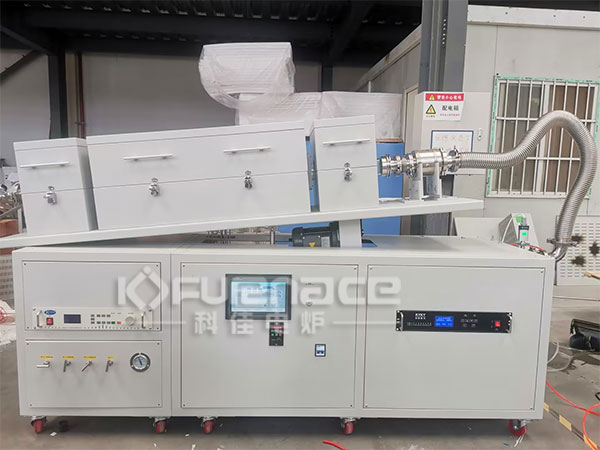
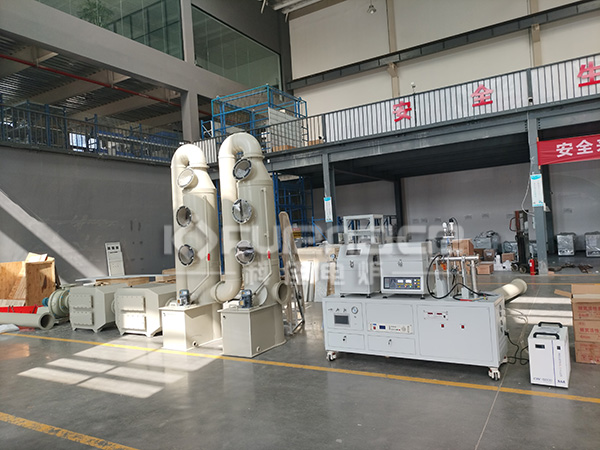
The PECVD multi gas path coating electric furnace is a commonly used equipment that combines plasma enhanced chemical vapor deposition (PECVD) technology with multi gas path control systems. It is widely used in fields such as microelectronics, optoelectronics, flat panel displays, energy storage, and photovoltaic manufacturing. Let’s take a detailed look below!
1. Equipment principle
The PECVD multi gas path coating electric furnace excites gas to generate plasma in a low-pressure environment through a radio frequency electric field, causing the gas containing the atoms of the thin film to form highly active species locally, and then deposit a solid thin film on the surface of the sample. Its core features include:
Low temperature deposition: Plasma energy reduces reaction activation energy, enabling efficient deposition at low temperatures of 200-400 ℃, avoiding thermal damage to the substrate material caused by high temperatures.
Multi gas path control: Equipped with multiple independent gas paths, reaction gases such as silane (SiH ₄), ammonia (NH3), oxygen (O ₂) can be introduced simultaneously or in a timed manner. The gas flow rate and proportion are precisely controlled by a mass flow meter (MFC) to achieve gradient design or doping control of the film composition.
Vacuum system: optional molecular pump or rotary vane pump can be used to maintain a high vacuum environment in the reaction chamber (with a vacuum degree of 10 ⁻ Pa), effectively removing impurities such as oxygen and water vapor from the air and ensuring the purity of the film.
Intelligent control: Integrated temperature, pressure, and gas flow multi parameter feedback adjustment, supporting programmed temperature control and automatic temperature rise/fall to ensure process stability.
2. Core advantages
Efficient deposition rate: Radio frequency glow technology greatly improves the growth rate of thin films, for example, the deposition rate of silicon nitride (Si3N4) thin films can reach 2-3 times that of traditional CVD, reducing production costs.
Good film quality:
Uniformity: Through gas flow design and temperature control system, the film thickness deviation is smaller and the composition uniformity is higher.
Density: Plasma bombardment reduces the porosity of the film, enhances adhesion, and improves pinhole density.
High purity: Vacuum environment suppresses pollution, with lower film impurity content, suitable for semiconductor grade applications.
Multi material compatibility: capable of depositing various materials such as SiO ₂, Si ∝ N ₄, Al ₂ O ∝, amorphous silicon (a-Si), etc., to meet the needs of different fields.
Low temperature process flexibility: suitable for thin film deposition on temperature sensitive substrates such as plastics and flexible substrates, expanding the application range.
Intelligent operation: functions such as intelligent gas path switching and RF power timing control simplify the operation process and improve experimental efficiency.
3. Application Fields
Microelectronics field:
Prepare insulation layers (such as SiO ₂, Si ∝ N ₄) and metal interconnect layers for transistors and integrated circuits.
Deposition of high dielectric constant (High-k) materials to enhance device performance.
In the field of optoelectronics:
Manufacturing anti reflective coatings (AR coatings) and anti reflective coatings for optoelectronic sensors and devices.
Deposition of transparent conductive oxide (TCO) thin films, such as indium tin oxide (ITO), for use in touch screens and solar cells.
Flat panel display field:
Prepare thin film transistor (TFT) arrays for liquid crystal displays (LCD) and organic light-emitting diodes (OLED).
Deposition of barrier layers on flexible substrates to enhance the lifespan of display devices.
Energy storage field:
Preparation of solid-state electrolytes (such as LiPON) and electrode protective layers for lithium-ion batteries to improve battery safety and cycle life.
Deposition of anti reflective films (such as SiN ₓ) for solar cells to improve photoelectric conversion efficiency.
Photovoltaic manufacturing:
Deposition of SiN ₓ anti reflection film on the surface of crystalline silicon solar cells to reduce light reflection loss.
Preparation of hole transport layer (such as Spiro OMeTAD) and electron transport layer (such as TiO ₂) for perovskite solar cells.
4. Selection suggestions
Process precision requirements:
If you need to deposit ultra-thin or complex structured thin films, choose equipment with high-precision temperature control (such as 30 segment program temperature control) and gas flow control.
For example, a six channel multi gas path vacuum PECVD coating electric furnace can achieve independent control of six gases, which is suitable for gradient thin film preparation.
Material compatibility:
Choose equipment with strong compatibility for different substrates (such as silicon, ceramics, metals) and thin film materials (such as silicon nitride, aluminum oxide, graphene).
For example, devices that support the input of solid and liquid precursors can flexibly optimize process conditions.
Budget and Scale:
Laboratory research and development can choose small vacuum CVD electric furnaces to meet basic research needs.
Industrial production prioritizes modular design equipment for quick changeover and capacity expansion.
Special requirements:
If it is necessary to prepare superhard coatings (such as diamond) or special structured thin films, plasma deposition PECVD technology or equipment with temperature gradient control can be selected.
For example, a multi zone PECVD tube furnace can achieve independent temperature control in different regions, which is suitable for the growth of complex structured thin films.
After sales service and maintenance:
Choose manufacturers that provide high-quality after-sales service and technical support to ensure stable operation of the equipment.
Consider equipment maintenance costs, such as heating element lifespan, vacuum pump maintenance cycle, etc.Click to learn more PECVD devices! Or click on online customer service to learn more about product information!
Contact Information
E-mail: