English
 简体中文
简体中文 Français
 日本語
日本語 한국어
한국어 Português
 Русский
 Español




Tel Number
181-3719-5600
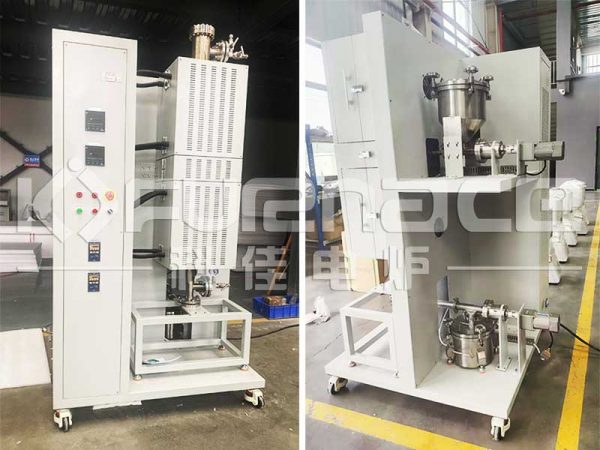
The vertical continuous feeding and discharging tubular furnace is a commonly used heat treatment equipment that integrates vertical structural design, automated material transfer, and high-temperature processing functions. Let’s take a closer look at this type of furnace!
1. Core Features
Vertical structure and spatial optimization
The furnace body adopts a vertical design, with materials being added from the top and discharged from the bottom after being heated in the furnace chamber. The structure is compact, occupies a small area, and is easy to install and move.
The heating elements are evenly distributed within the furnace chamber to ensure uniformity of the temperature field (±5℃), thereby enhancing heating efficiency and product quality.
Continuous feeding and discharging with automatic control
Support continuous or intermittent movement of materials through different temperature zones to achieve sustained production and improve production efficiency.
Equipped with a microcomputer program control system, it allows for the input of multiple heating, holding, and cooling curves, supports multi-segment program programming, and enables remote fault diagnosis.
Atmosphere control and vacuum operation
It can be pre-evacuated to a vacuum (with a higher vacuum level available upon customization) and filled with various gases (such as hydrogen, argon, and nitrogen) to meet process requirements for oxidation, reduction, inerting, and other processes.
The design of the sealing flange and stainless steel globe valve ensures the stability and safety of the atmosphere.
Efficient, energy-saving, and environmentally friendly design
Equipped with a high-purity alumina fiber furnace chamber and superior insulation materials, it boasts high thermal efficiency and low energy consumption.
Equipped with an RS-485 communication interface and data management software, it supports paperless recording of historical data and temperature rise curves, optimizing process parameters.
2. Working Principle
Energy conversion and heat transfer
Heating elements (such as resistance wires and silicon carbide rods) convert electrical energy into thermal energy, which is then transferred to the furnace tube through thermal radiation and conduction.
The furnace tube then transfers the heat to the material inside the tube, completing the heating process.
Temperature control mechanism
The thermocouple monitors the temperature inside the furnace in real time, and the temperature control instrument adjusts the heating power through the PID algorithm to maintain a constant temperature or change according to a set program.
Fuzzy PID control and self-tuning adjustment function ensure temperature control accuracy to ±1℃.
Material movement and heat treatment
The material moves continuously or intermittently within the furnace chamber, passing through different temperature zones to complete process steps such as heating, heat preservation, and cooling.
3. Application Fields
scientific research
Material property research: Simulating the performance of materials in practical applications, such as phase transition laws at high temperatures and crystal growth mechanisms.
Preparation of new materials: used for processes such as oxidation, evaporation, and deposition of semiconductor materials (such as silicon wafers).
Sample processing: Conduct high-temperature treatment, sintering, or annealing on materials such as metals, ceramics, and plastics.
industrial production
Metal heat treatment: processes such as quenching, tempering, and annealing, aimed at improving the mechanical properties, hardness, and strength of materials.
Ceramic sintering: ensuring the density, hardness, and strength of ceramic products, such as ceramic tiles and utensil manufacturing.
Glass processing: processes such as hot bending, melting, and vessel manufacturing, which can control heating temperature and atmospheric environment.
New energy field: preparation and heat treatment of positive and negative electrode materials for lithium batteries, optimizing material performance and stability.
chemical industry
High-temperature reaction: processes such as catalyst preparation, sintering, and activation, providing a stable heating environment.
4. Selection Suggestions
Temperature requirements: Select the temperature range (such as 600℃ to 1700℃) according to process requirements, and confirm the type of heating element (resistance wire, silicon carbide rod, silicon molybdenum rod).
Furnace tube size and material: The diameter of the furnace tube and the length of the heating zone are selected based on the size and quantity of the material. The available materials include quartz tubes, corundum tubes, alloy tubes, etc.
Atmosphere control and vacuum degree: Confirm whether a vacuum environment or a specific atmosphere (such as inert gas, reactive gas) is required, and select the corresponding sealing and gas introduction system.
Temperature control accuracy and uniformity: For temperature-sensitive materials, it is necessary to choose a high-precision temperature control model (±1℃) and confirm the length of the constant temperature zone and temperature uniformity.
Automation and expansion functions: Choose whether to equip automatic feeding and discharging systems, rotating structures, remote control, and other functions according to production needs.
Brand and after-sales service: Choose suppliers with mature technology and comprehensive services to ensure equipment stability and after-sales service quality.Click to learn more Customized Tube Furnaces! Or click on online customer service to learn more about product information!
Contact Information
E-mail: