English
 简体中文
简体中文 Français
 日本語
日本語 한국어
한국어 Português
 Русский
 Español




Tel Number
181-3719-5600
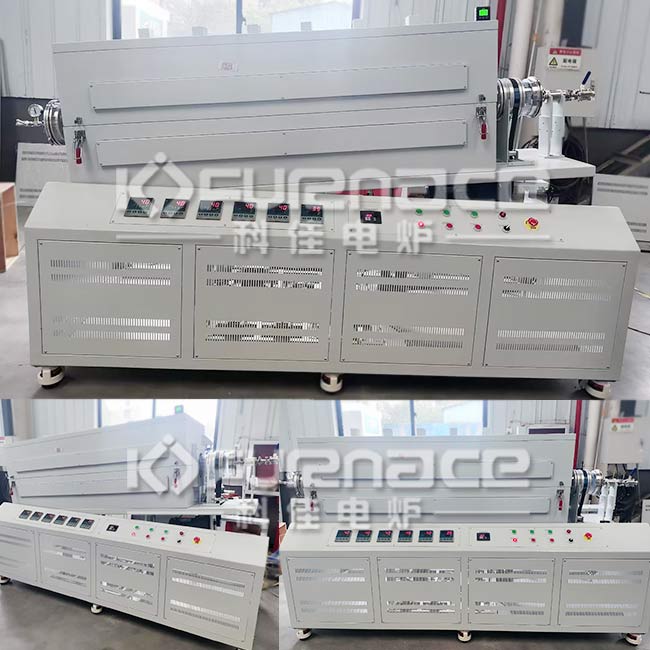
The laboratory multi temperature zone tube furnace is a core equipment for scientific research experiments in fields such as materials science, chemical engineering, and metallurgical engineering. With the advantages of independent temperature control in multiple temperature zones and convenient adjustable temperature field, it is widely used in experimental scenarios such as new material synthesis, powder sintering, atmosphere heat treatment, and catalyst calcination. Unlike industrial grade multi zone tube furnaces, laboratory equipment focuses more on precision, compactness, flexibility, and ease of operation. Its parameter configuration directly determines the accuracy and efficiency of experimental data. Let’s take a look at the core parameter configuration of the multi temperature zone tube furnace in the laboratory, and share practical selection techniques to help researchers and laboratory purchasers make more accurate selections, avoid pitfalls, and better utilize the experimental value of the equipment.
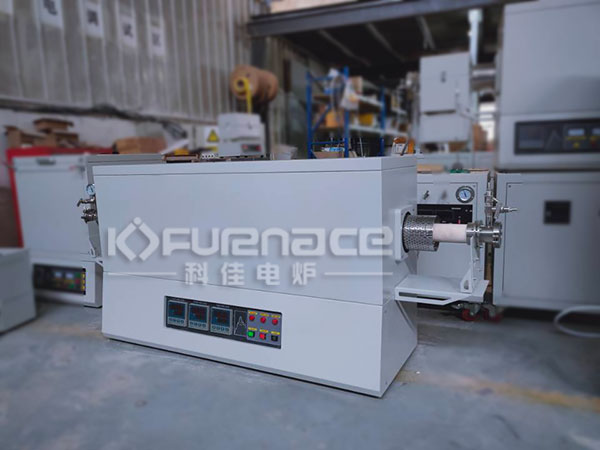
Three commonly used gradient tube furnaces (click on the image to view product details)
1. Interpretation of Core Parameter Configuration for Multi temperature Zone Tube Furnace in Laboratory (Must See)
The parameter configuration of the multi temperature zone tube furnace in the laboratory revolves around five dimensions: “temperature zone, temperature, temperature control, furnace tube, and gas path”. Each parameter is directly related to the experimental effect and needs to be focused on:
a. Temperature zone related parameters (core core)
The number and length of temperature zones determine the flexibility and applicability of the experiment, which is the first consideration for laboratory selection.
-Number of temperature zones: The laboratory commonly uses 2-5 temperature zones, with the mainstream being 3 temperature zones (independent temperature control in the front, middle, and back stages); Simple experiments can choose 2 temperature zones, while complex multi-stage reaction experiments (such as segmented heating and gradient reactions) are recommended to choose 4-5 temperature zones, which can achieve temperature gradient control in different zones.
-Single temperature zone length: The conventional single temperature zone length is 50-100mm, and the total furnace length is adjusted according to the number of temperature zones (such as a total furnace length of about 300-1000mm for 3 temperature zones); It is necessary to select according to the size of the experimental workpiece and the requirements of the reaction area, ensuring that the reaction area is completely within the effective temperature zone, and avoiding temperature field fluctuations that affect the experiment.
-Independence of temperature zones: The key is whether each temperature zone can be independently controlled and programmed without temperature crosstalk, otherwise it will lead to uncontrolled gradient temperature and affect experimental data.
b. Temperature related parameters (key to experimental accuracy)
Laboratory experiments require high temperature accuracy, with a focus on the following three parameters:
-Maximum working temperature: The commonly used temperature range in the laboratory is 800-1600 ℃, which needs to be selected according to the experimental process (such as 800-1200 ℃ for ordinary powder sintering and 1400-1600 ℃ for high-temperature ceramic synthesis); It is recommended to choose a long-term working temperature 50-100 ℃ higher than the required temperature for the experiment to avoid long-term full load operation of the equipment and extend its service life.
-Temperature control accuracy: Laboratory grade equipment should reach ± 1 ℃ or above. Insufficient temperature control accuracy can lead to experimental data deviation and affect experimental repeatability.
-Uniformity of temperature field: The temperature difference within the effective temperature zone should be controlled within ± 3 ℃~± 5 ℃. The better the uniformity, the more complete the reaction of experimental materials, and the more accurate the data; When selecting, the manufacturer can be requested to provide a temperature field uniformity test report to avoid false parameter labeling.
c. Furnace tube parameters (adapted to experimental materials and atmosphere)
The furnace tube is the core component of the multi temperature zone tube furnace in the laboratory, and its material and size directly determine the adaptability of the experimental scene:
-Furnace tube materials: commonly used quartz tubes in the laboratory (high temperature resistance ≤ 1200 ℃, transparent and easy to observe, suitable for routine experiments), corundum tubes (high temperature resistance ≤ 1600 ℃, corrosion resistance, suitable for high temperature experiments), silicon carbide tubes (high temperature resistance ≤ 1700 ℃, thermal shock resistance, suitable for frequent temperature rise and fall experiments), metal tubes (high temperature resistance ≤ 1000 ℃, although not as high as other pipe materials, the pipe diameter can be made very large, can be used for hundred kilogram production type, and is more resistant to high vacuum state); Select according to the experimental temperature and material characteristics to avoid material intolerance causing furnace tube rupture.
-Furnace tube size: The commonly used inner diameter is Φ 30-800mm, and the length matches the total length of the temperature zone; The selection should be based on the amount and size of the experimental materials. If the inner diameter is too large, it can easily lead to uneven temperature field, while if it is too small, it cannot meet the material loading requirements.
-Sealing performance: If the experiment requires atmosphere protection (such as inert gas, reducing gas), a sealed furnace tube should be selected, equipped with high-temperature resistant seals to ensure no gas leakage and avoid affecting the experimental environment and results.
d. Temperature control and program parameters (improving experimental efficiency)
Laboratory experiments often require multiple temperature control programs to reduce manual operation and improve experimental reproducibility
-Program temperature control function: It needs to support multi segment program programming (at least 30 segments), and can set the heating, insulation, and cooling rates (adjustable heating rate of 0.1-20 ℃/min) to achieve full process automated temperature control and adapt to complex experimental processes.
-Temperature control method: Priority should be given to intelligent digital temperature control, combined with PT100 thermocouple temperature measurement, for accurate temperature measurement and convenient operation; High end devices can be equipped with touch screens, supporting data recording and curve viewing, making it easy to trace experimental data.
-Protection function: It must have over temperature alarm, power-off protection, and overcurrent protection functions to prevent experimental failure and equipment damage caused by operational errors or equipment failures, ensuring laboratory safety.
e. Gas path and auxiliary parameters (adapted to complex experimental scenarios)
For experiments that require atmosphere control, gas path parameters cannot be ignored:
-Number of gas channels: Conventional 1-2 gas channels (suitable for single atmosphere protection), multiple gas channels (2-4 channels) can be selected for complex experiments, supporting multiple gas mixing and independent flow control, suitable for oxidation-reduction, gas doping and other experiments.
-Auxiliary functions: It is recommended to choose small, lightweight, and easy to move models for laboratory equipment to facilitate laboratory layout; Can be paired with a vacuum interface to achieve vacuum sintering experiments; Some devices can be equipped with cooling systems to accelerate the cooling rate and improve experimental efficiency.
2. Selection Techniques for Multi temperature Zone Tube Furnaces in Laboratories (Pit Avoidance Guide)
By combining laboratory experimental requirements and equipment characteristics, mastering the following four selection techniques can avoid blind selection and select suitable, durable, and convenient equipment:
a. First, clarify the experimental requirements and reject ‘excessive configuration’
Before selecting, first sort out the core experimental requirements: clarify the experimental temperature, temperature zone quantity requirements, material size and dosage, whether atmosphere protection/vacuum environment is needed, and the complexity of the experimental process. For example, in conventional powder sintering experiments, a model with 3 temperature zones, a maximum temperature of 1200 ℃, and quartz furnace tubes can be selected; For high-temperature ceramic synthesis experiments, it is necessary to select a model with 4-5 temperature zones, a maximum temperature of 1600 ℃, and a corundum furnace tube; Experiments that do not require complex atmosphere control, do not require additional configuration of multiple gas paths, and avoid increasing procurement costs.
b. Prioritize the accuracy of parameters and reject ‘false labeled parameters’
Laboratory experiments require high precision in parameters, so when purchasing, do not only focus on price and ignore the issue of parameter labeling. Focus on verifying the uniformity of the temperature field, temperature control accuracy, and independence of the temperature zone, and require the manufacturer to provide authoritative test reports; On site testing of temperature control stability of equipment to avoid significant differences between actual parameters and labeled parameters, which may lead to distortion of experimental data.
c. Adapt to laboratory scenarios while considering operational convenience
Due to limited laboratory space, priority should be given to models that are compact, lightweight, easy to install, and operate to avoid equipment occupying too much space due to their large size; The operating interface should be simple and easy to understand, with convenient temperature control functions for researchers to quickly get started; At the same time, pay attention to the noise and energy consumption of the equipment, choose low-noise and low-energy models, and adapt to the laboratory environment.
d. Pay attention to manufacturer qualifications and after-sales service to ensure long-term use
The multi temperature zone tube furnace in the laboratory is a precision equipment, and after-sales support is very important. Priority should be given to manufacturers with professional R&D and production qualifications, experience in laboratory equipment production, and the ability to provide customized services; Confirm that the manufacturer provides free installation and debugging, operation training, and warranty services (at least 1 year), stable supply of vulnerable parts (such as furnace tubes and seals), and quick response in case of faults to avoid affecting the experimental progress.
3. Summary
The selection of multi temperature zone tube furnaces in the laboratory is based on the principle of “matching experimental needs well”. The key is to set the core parameters such as temperature control zone, temperature, furnace tube, and temperature control to avoid excessive configuration and parameter labeling. Researchers and procurement personnel can combine the parameter interpretation and selection techniques outlined in this article to clarify their own experimental needs, focus on verifying equipment accuracy and adaptability, and choose manufacturers with complete qualifications and excellent after-sales service to select cost-effective, stable and durable equipment, providing reliable support for experimental research.Click to learn more customized tube furnaces! Or click on online customer service to learn more about product information!
Contact Information
E-mail: