English
 简体中文
简体中文 Français
 日本語
日本語 한국어
한국어 Português
 Русский
 Español




Tel Number
181-3719-5600
In the industries of powder metallurgy, new energy powders, special ceramics, hard alloys, and inorganic new materials, tubular powder sintering furnaces are the core heat treatment equipment for powder calcination, atmosphere sintering, and vacuum densification. Many R&D and production enterprises are prone to pitfalls in selection: the cost of small-scale trial production furnaces is wasted, the production capacity of small-scale trial furnaces used in mass production is insufficient, and problems such as uneven powder sintering, oxidation agglomeration, and large temperature field deviation occur after process scaling up. Below, we will systematically sort out the selection criteria for tubular powder sintering furnace models in three stages: small-scale research and development, pilot scale, and industrial mass production. Based on powder material, temperature, atmosphere, and daily processing capacity, we will help you match equipment more accurately and achieve smooth production from the laboratory.
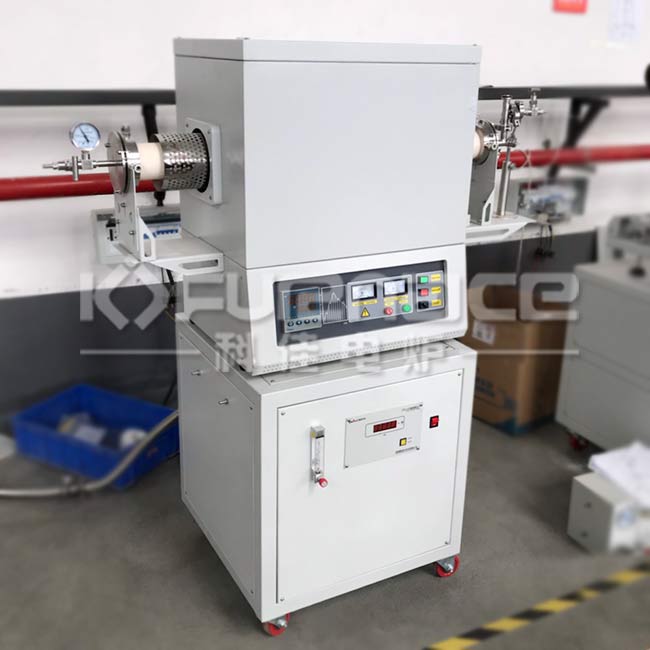
A commonly used high-temperature vacuum tube furnace (click on the image to view product details)
1. Small scale R&D grade tubular powder sintering furnace: dedicated for formula sampling and process exploration
Applicable scenarios
University laboratories, new material research and development enterprises, and formula testing laboratories are used for new powder formula testing, sintering parameter exploration, and small batch sample verification. The single feeding is several grams to 3kg, with the aim of exploring heating curves, atmosphere ratios, and better sintering temperatures, without pursuing mass production capacity.
Mainstream models and parameter references (KJ-TG series)
KJ-T1200-MINI type (1200 ℃)
Furnace tube with standard diameter of 50/60mm quartz/corundum tube, constant temperature zone of 200-300mm, single temperature zone PID intelligent temperature control, temperature control accuracy of ± 1 ℃; Standard configuration includes a simple vacuum unit and a single air inlet, supporting nitrogen, argon, and trace reducing atmospheres, suitable for sintering iron oxide, ordinary ceramic powder, and low-temperature alloy powder. Single batch feeding of 5g~800g, with small equipment footprint, can be used with civilian voltage, and is a commonly used basic small test furnace in the market.
KJ-T1700 High Temperature Tube Furnace
Maximum constant temperature of 1600-1700 ℃, silicon molybdenum rod heating element, optional corundum/silicon carbide furnace tube, supports high vacuum configuration, suitable for high-temperature sintering of silicon carbide, aluminum nitride, tungsten molybdenum refractory metal powder, high-purity ceramic powder; Optional micro rotating structure to solve the problem of fine powder sintering agglomeration, with a single feeding of 10g~3kg, suitable for high-temperature special powder research and development sampling.
Key points of small-scale selection
Reserve a 10% margin for the inner diameter of the furnace tube, and ensure that the overall size of the powder and crucible is smaller than the inner diameter of the furnace tube to avoid material jamming and local poor heating;
Priority should be given to selecting KF flange seals and mechanical pump vacuum systems for easily oxidizable metal powders to isolate air;
Only for atmospheric pressure sintering, a simple gas path can be selected, and for vacuum sintering, a two-stage vacuum pump set can be directly selected.
2. Pilot scale scale-up tubular powder sintering furnace: process implementation, batch trial production transition model
Applicable scenarios
After the small-scale trial process is finalized, kilogram level batch trial production is carried out to verify the continuous sintering stability and powder yield. The single feeding is 5-50kg/batch, with a daily production capacity of tens to hundreds of kilograms. Connecting small-scale trial and mass production, most new energy negative electrode materials, catalysts, and ceramic powder enterprises can choose this stage of equipment, which is also a key link in process optimization.
Classification and models of mainstream furnace types
1. Intermittent rotary tube furnace (KJ-TX series)
Model: KJ-TX100-S150LK3W, KJ-T1700, furnace tube inner diameter of φ 150~φ 300mm, furnace body inclination angle of 0-5 ° electrically adjustable, speed of 0-10r/min variable frequency speed regulation; The powder rolls and heats up inside the furnace tube, completely solving the problems of temperature difference and agglomeration of fine powder in static tube furnaces, and adapting to various types of flowable powders. Temperature range of 1000-1700 ℃, multi-channel atmosphere control cabinet, capable of accurately proportioning multiple gases, single batch feeding of 8-35kg, daily production capacity of 80-300kg.
2. Multi zone horizontal tube furnace (KJ-TX series)
Model: KJ-TX1600-L60LB2, multi-stage independent temperature control, with a constant temperature zone of up to 1000-1800mm for the entire furnace, and a temperature field uniformity within ± 5 ℃. It is suitable for long boat loading, block+powder mixed sintering, with furnace tube diameter of 200-350mm and a single loading of 10-50kg. It is suitable for pilot sintering of hard alloy powder and zirconia ceramic powder.
Trial selection requires attention to details
The pilot furnace retains adjustable parameter space (speed, heating rate, atmosphere flow rate) for easy fine-tuning and upgrading of subsequent mass production processes;
The powder contains a corrosive atmosphere, and high-purity corundum material is preferred for furnace tubes, while quartz tubes are rejected;
Enterprises planning to expand production in the later stage should reserve interfaces for pilot furnaces to facilitate the installation of continuous feeding devices in the later stage.
3. Industrial mass production tubular powder sintering furnace: specialized for continuous large-scale production
Applicable scenarios
The process is fully mature and put into large-scale production, with a daily output of 500kg~several tons. It is mainly used for the production of lithium battery powder, large-scale powder metallurgy, chemical catalysts, and mass-produced ceramic powder production lines. The commonly used is the spiral feed rotary tube furnace (KJ-TX series).
Mainstream models and parameters for mass production
KJ-TX1000-H400LK4, KJ-TX1000-L150CK3W continuous spiral tube furnace
The furnace tube has a diameter of 300~800mm and is equipped with a closed spiral automatic feeding and continuous discharge system. The powder is transported in a closed manner without dust; Multi temperature zone segmented temperature control of the furnace body, integrated design of pre sintering section, high-temperature sintering section, and slow cooling section, customized temperature range of 800~1600 ℃ as needed, supporting continuous production in various inert/reducing/vacuum atmospheres, with an hourly production capacity of 5-200kg, is a standard equipment for mass production of new energy powders.
Large rotating tube sintering furnace
The closed furnace is equipped with a fully automatic boat pushing mechanism, and the feeding bin is continuously fed, suitable for ultrafine and dust prone powders. The entire line is controlled by a PLC centralized control system, which can store hundreds of sintering processes with one click and is suitable for mass production of high-density hard alloy powders. The entire line can be equipped with exhaust gas treatment and atmosphere circulation recovery systems to reduce production costs.
Guidelines for avoiding pitfalls in mass production selection
Priority is given to fully enclosed negative pressure structure for large quantities of fine powder to prevent dust leakage and powder oxidation loss;
Continuously operating at high temperatures year-round, the insulation layer uses energy-saving high-purity ceramic fibers, which are more energy-efficient than traditional refractory bricks and save electricity costs in the long run;
Production furnaces with flammable and explosive atmospheres such as hydrogen are equipped with explosion-proof valves, over temperature interlocks, and emergency nitrogen replacement systems to ensure the safety of the production line.
4. Four core parameters for universal selection (universal reference for all stages)
Sintering temperature fixed heating element: Resistance wire is selected for temperatures ≤ 1200 ℃, silicon carbon/silicon molybdenum rod is used for temperatures between 1200~1600 ℃, and graphite heating element is used for temperatures above 1600 ℃ (in a vacuum environment);
Powder morphology and furnace structure: For loose fine powder, a rotary/spiral continuous tube furnace is selected, while for block+powder mixing, a horizontal multi temperature zone tube furnace is selected;
Sealing configuration for atmosphere requirements: Inert atmosphere simple flange, vacuum sintered KF vacuum flange, magnetic fluid seal, reducing gas all metal water-cooled seal;
Capacity planning reserved for expansion: Due to limited budget in the early stage, priority should be given to selecting non-standard customized furnaces that support later installation of feed and expansion of multiple temperature zones.
5. Summary
The selection of tubular powder sintering furnaces follows the principles of flexible small trial weight, adjustable medium trial weight, and continuous mass production weight: R&D sampling prioritizes small trial single temperature zone tubular furnaces, process validation selects trial rotary/multi temperature zone furnaces, and large-scale production selects continuous rotary tubular production furnaces. If the powder category is special (ultra-high temperature, strong corrosion, high activity), non-standard furnace and atmosphere systems can be customized according to the raw material composition and sintering process. Kejia electric furnace source manufacturers can provide a one-to-one furnace configuration plan based on the customer’s existing sintering process to avoid economic losses caused by equipment idle and production capacity not meeting standards due to selection errors.Click to learn more customized tube furnaces! Or click on online customer service to learn more about product information!
Contact Information
E-mail: