English
 简体中文
简体中文 Français
 日本語
日本語 한국어
한국어 Português
 Русский
 Español




Tel Number
181-3719-5600
The laboratory vertical tube furnace is a mainstream high-temperature atmosphere equipment used by universities, research institutes, new material enterprises, and chemical laboratories for CVD film preparation, powder calcination, metal annealing, lithium battery raw material sintering, and nano material synthesis. The selection of ventilated vertical tube furnace focuses on three key elements: matching the temperature range, adapting the experimental atmosphere type, and selecting the furnace tube material. Choosing the wrong parameters can easily lead to furnace tube explosion, sample contamination, sudden reduction in furnace life, and airtightness failure. Below is a comprehensive disassembly and selection logic based on commonly used laboratory conditions, including temperature classification, atmosphere classification, four mainstream furnace tube materials, supporting configurations, and pit avoidance points, to help you more accurately select a vertical atmosphere tube furnace that is suitable for your own experiment!
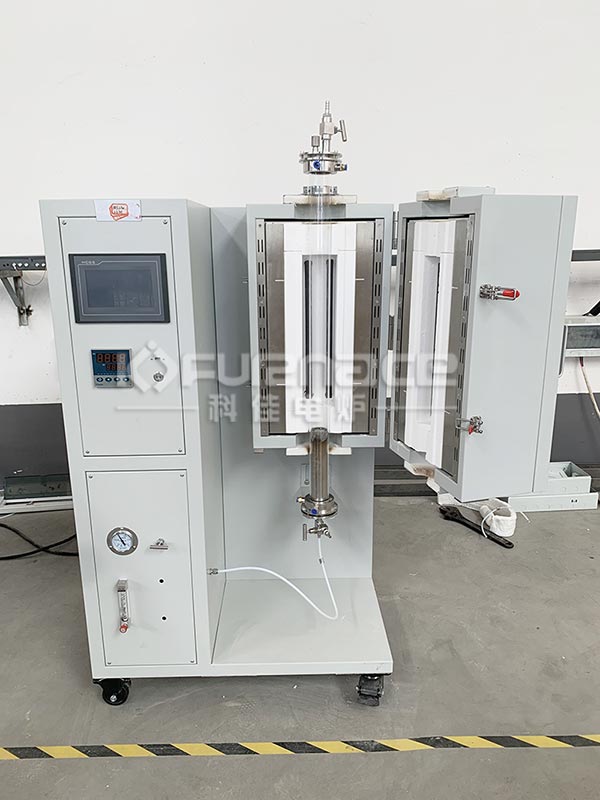
Touchscreen vertical fluidized bed tube furnace (click on the image to view product details)
1. Pre set operating temperature: Select heating elements according to the long-term working temperature range and reserve a safety margin
The first step in selecting a ventilated vertical tube furnace is to lock the temperature parameters, and it is strictly prohibited to select based on the instantaneous highest temperature. It is customary to reserve a continuous use margin of 100-200 ℃ to avoid long-term full load operation accelerating the aging of electric heating elements and furnace deformation. The vertical furnace tube structure has a uniform temperature field, and the heating materials and applicable processes for different temperature zones are clearly distinguished
1.1 Low temperature range: ≤ 1100 ℃, heated with iron chromium aluminum/nickel chromium resistance wire
Long term stable working temperature ≤ 1000 ℃, equipped with N-type thermocouple temperature measurement, high cost-effectiveness.
Applicable: Organic matter pyrolysis, low-temperature catalyst calcination, ordinary powder drying, aluminum alloy low-temperature annealing; Paired with quartz furnace tubes, it is commonly used for conventional inert atmosphere experiments in air and nitrogen, and is the preferred choice for basic laboratories with limited budgets.
1.2. Medium temperature range: 1200 ℃~1350 ℃, heated with silicon carbide rod
The maximum continuous use temperature is 1300 ℃, and an S-type thermocouple is selected for temperature measurement, making it more versatile in the laboratory.
Applicable: oxide powder calcination, conventional ceramic pre firing, lithium battery precursor heat treatment; The atmosphere supports weak inert environments of air, nitrogen, and argon, and the furnace tube can be made of alumina and corundum (above 1200 ℃).
1.3 High temperature section: 1400 ℃~1700 ℃, heated with silicon molybdenum rod (molybdenum disilicide)
Long term safe use at 1500-1600 ℃, instantaneous peak at 1700 ℃, paired with B-type platinum rhodium thermocouple; Silicon molybdenum rods should not be kept at a constant temperature of 400-800 ℃ for a long time, as they are prone to oxidation and pulverization at low temperatures.
Applicable: SiC ceramic sintering, single crystal growth, CVD graphene/carbon nanotube preparation, high-temperature reduction of hard alloys; It must be equipped with high-purity alumina corundum tubes or silicon carbide furnace tubes, suitable for inert and reducing high-temperature ventilation conditions, which is the mainstream configuration of high-temperature ventilation vertical furnaces in new materials laboratories.
Selection tip: For daily experiments with a constant temperature of 1300 ℃, it is recommended to choose a vertical tube furnace with silicon molybdenum rods at a maximum temperature of 1600 ℃. Excess temperature can extend the service life of the equipment and meet the needs of subsequent experimental upgrades.
2. Differentiate atmospheres as needed: 4 major types of ventilation conditions determine the sealing and gas path configuration of the furnace body
The core advantage of a vertical tube furnace is that the vertical airflow flows uniformly from top to bottom, the powder is less likely to dust and hang on the wall, and the sample has good consistency in heating. Different experimental gases correspond to completely different sealing structures, gas path accessories, and safety levels. The ventilation furnace must be equipped with flanges, flow meters, and explosion-proof accessories according to the gas type to avoid gas leakage and tempering hazards.
2.1. Air oxidation atmosphere (O ₂, air)
Only air and oxygen are introduced for oxidation sintering, without the need for high sealing. Simple flange sealing is sufficient, without vacuum configuration; Suitable for oxide calcination, ceramic oxidation sintering, and gas path with ordinary glass rotor flowmeter.
2.2. Inert protective atmosphere (N ₂ nitrogen, Ar argon)
Isolate oxygen to prevent sample oxidation, with stainless steel flanges and silicone seals at both ends, and standard MFC mass flow controller for more accurate gas control; Nitrogen has a high cost performance ratio and is used for conventional protection. Argon has stronger inertness and is suitable for high-precision experiments such as semiconductor wafer annealing and high-purity nanomaterial synthesis. Priority is given to selecting structures that can be pre evacuated to replace gas, and the deoxygenation effect is better than simple gas blowing.
2.3. Reductive atmosphere (H ₂ hydrogen, CO carbon monoxide)
Strong reducing gases are flammable and explosive, and explosion-proof vertical tube furnaces must be selected: explosion-proof sealing flanges, exhaust combustion devices, overpressure relief valves, hydrogen leak detection modules; The gas path is made of all stainless steel seamless pipeline, and rubber seals are prohibited. Hydrogen gas can be introduced after pre vacuuming. It is mainly used for metal oxide reduction, bright annealing of metal powder, and sintering of negative electrode materials.
2.4. Corrosive special atmosphere (acidic gases such as hydrogen sulfide and hydrogen chloride)
The furnace body flange is coated with anti-corrosion coating, and the furnace tube avoids ordinary quartz and carbon steel, with priority given to silicon carbide and high-purity dense corundum. The gas path uses polytetrafluoroethylene valve pipelines, and customized anti-corrosion sealing kits are commonly used for chemical catalytic material corrosion environment experiments.
Vacuum matching: A mechanical pump (low vacuum -0.09MPa) is required for deep deoxygenation, and a molecular pump (maximum vacuum 10 ⁻ Pa) is selected for semiconductor high-purity processes to achieve dual use of high vacuum and atmosphere switching.
3. Furnace tube material selection: 4 mainstream pipe materials, temperature+atmosphere dual dimensional comparison
Furnace tubes are the core consumables of ventilated vertical tube furnaces, which come into direct contact with gases and samples. Choosing the wrong material can result in high-temperature leakage, impurity precipitation, sample contamination, pipe explosion and scrapping. The parameters and adaptation scenarios of the four mainstream furnace tubes in the market are quartz, corundum, silicon carbide, and 316L stainless steel
3.1 High purity quartz furnace tube (SiO ₂ ≥ 99.9%)
Temperature resistance: Long term ≤ 1100 ℃, short-term 1200 ℃, over temperature softening and loss of permeability;
Advantages: Fully transparent and visible, allowing real-time observation of sample reactions inside the furnace, resistant to thermal shock, with a temperature rise and fall rate of up to 20 ℃/min, and affordable price;
Taboo: Long term exposure to hydrogen gas at high temperatures can lead to crystallization and cracking, and is not resistant to hydrofluoric acid corrosion;
Adaptation: Low temperature ventilation experiment with air/nitrogen below 1100 ℃, standard for university basic laboratories.
3.2. High purity corundum furnace tube (Al ₂ O ∝ 99 ceramic/95 ceramic)
Temperature resistance: 95 ceramic with a long-term temperature of 1400 ℃, 99 high-purity corundum with a long-term temperature of 1600 ℃, and short-term pressure resistance of 1700 ℃;
Advantages: Excellent chemical stability, acid and alkali resistance, strong compatibility with inert/reducing atmospheres, no metal impurities precipitation at high temperatures, and no pollution of raw materials during powder sintering;
Shortcomings: Moderate resistance to thermal shock, recommended temperature rise and fall ≤ 10 ℃/min, prone to cracking due to rapid heating and cooling, opaque and unable to observe the interior;
Adaptation: High temperature ventilation above 1200 ℃, hydrogen reduction, ceramic/lithium powder calcination, preferred furnace tube for high temperature vertical atmosphere furnace.
3.3. Silicon carbide SiC furnace tube
Temperature resistance: Long term 1500 ℃, short-term 1650 ℃;
Advantages: Fast thermal conductivity, better resistance to thermal shock across all categories, rapid temperature rise and fall, strong wear and corrosion resistance, high temperature strength, and a longer service life than corundum;
Shortcoming: Opaque, higher cost than ordinary corundum;
Adaptation: Frequent start stop heating and cooling, corrosive atmosphere, rotating vertical tube furnace, continuous production laboratory equipment.
3.4 316L stainless steel furnace tube
Temperature resistance: Long term ≤ 850 ℃, over temperature surface oxidation and peeling;
Advantages: high mechanical strength, easy sealing and processing, strong resistance to hydrogen reduction;
Shortcoming: High temperature precipitation of metal ions, which cannot be used for high-purity powder experiments;
Adaptation: Heat treatment of crude materials with hydrogen reduction at temperatures below 800 ℃, and industrial pilot scale simple ventilation furnace.
4. Key configuration selection points for vertical tube furnace matching
4.1 Temperature control system: Scientific research grade preferred programmable PID temperature control with 30 or more segments, temperature control accuracy of ± 1 ℃, equipped with triple protection for breaking couples, overheating, and leakage; A simple experiment can use a 10 stage program for temperature control, with adjustable heating and cooling rates ranging from 0.5 to 10 ℃/min.
4.2 Furnace material: High purity alumina polycrystalline ceramic fiber furnace is preferred, which does not shed powder at high temperatures, has low heat storage, and is energy-saving and insulated. It avoids inferior ordinary aluminum silicate fibers (which may contaminate samples by powdering at temperatures above 1200 ℃).
4.3. Furnace tube size: The commonly used vertical tube diameter is Φ 50/Φ 60/Φ 80/Φ 100mm, and the height is customized according to the size of the loading crucible. For small samples, choose a small tube diameter, and for bulk powders, choose a large-diameter vertical furnace. The upper and lower openings are convenient for loading and discharging.
4.4 Gas path system: Glass rotor flowmeter is used for small amounts of gas, MFC mass flow controller is necessary for precise multi-component gas ratio, and independent flow control is required for multiple intake channels.
5. Guide to Choosing High Frequency Avoiding Pits
5.1. Only look at the maximum temperature and not the continuous working temperature: The merchant indicates that the peak value of 1700 ℃ ≠ long-term use of 1700 ℃. The continuous rated temperature of silicon molybdenum rod models is mostly 1600 ℃. Confirm the long-term working temperature in writing before placing an order;
5.2. The hydrogen reduction furnace is equipped with ordinary rubber sealing rings: the hydrogen working condition must be fully sealed with metal/graphite, and there is a risk of explosion due to high temperature aging and gas leakage of rubber;
5.3. Selection of quartz furnace tube for high temperature conditions: Quartz is strictly prohibited for ventilation experiments above 1200 ℃, as it is prone to softening and gas leakage. Instead, corundum/silicon carbide should be used;
5.4 Blindly purchasing inferior furnaces at low prices: The low-priced fiber furnace loses powder at high temperatures, and the powder samples are directly scrapped, resulting in maintenance costs far exceeding the price difference of the purchased machine.
6. Summary of Quick Selection for Different Application Scenarios
6.1. University Basic Laboratory (Low temperature Nitrogen Baking): 1200 ℃ Resistance Wire Vertical Furnace+Quartz Tube+Single channel Nitrogen Flow Meter;
6.2. New Materials Laboratory (1550 ℃ CVD, hydrogen reduction): 1600 ℃ silicon molybdenum rod explosion-proof vertical furnace+corundum tube+MFC+pre vacuum system;
6.3 Chemical corrosion atmosphere experiment: 1500 ℃ silicon molybdenum rod furnace+silicon carbide furnace tube+anti-corrosion gas path;
6.4. Pilot batch powder sintering: medium temperature silicon carbon rod vertical furnace+95 corundum tube+multi-channel atmosphere control system.
Conclusion
The selection of laboratory ventilated vertical tube furnace requires matching the temperature fixed heating element, atmosphere fixed sealing and safety configuration, and process fixed furnace tube material one by one to balance experimental stability and equipment service life. By clarifying the three major parameters of the highest constant temperature in the experiment, the type of gas introduced, and the physical and chemical properties of the sample before procurement, selection errors can be significantly reduced. Non standard pipe diameter and multi temperature zone vertical tube furnaces can be customized as needed to meet personalized scientific research process requirements.Click to learn more customized tube furnaces! Or click on online customer service to learn more about product information!
Contact Information
E-mail: