English
 简体中文
简体中文 Français
 日本語
日本語 한국어
한국어 Português
 Русский
 Español




Tel Number
181-3719-5600
In high-temperature processes such as silicon carbide sintering, crystal growth, and advanced ceramic preparation, the utilization rate of vertical tube furnaces is increasing. What is the difference between a vertical structure and a traditional horizontal structure for a tube furnace? Why do more and more laboratories and production lines tend to choose vertical ones? Now let’s explain the advantages of the vertical structure and tell you which high-temperature processes it is suitable for.
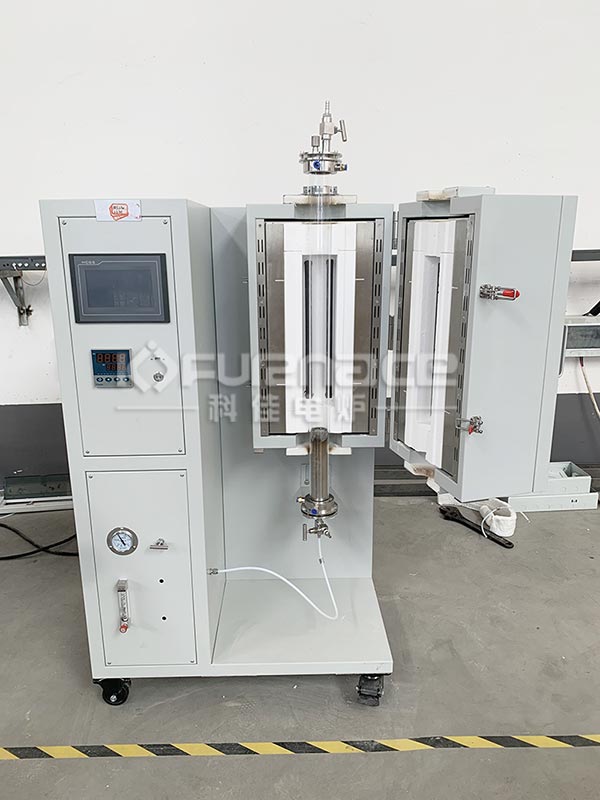
KJ-1100-V60 fluidized bed tube furnace (click on the picture to view product details)
1. What is the difference between vertical and horizontal?
First, clarify the essential difference between the two structures.
Horizontal tube furnace: The furnace tube is placed horizontally, the sample is pushed in from the side, and the heating element is arranged around the horizontal section of the furnace tube;
High temperature vertical tube furnace: The furnace tube is placed vertically, and the sample is loaded from the upper or lower end. The heating element surrounds the furnace tube in the vertical direction.
Don’t underestimate this’ vertical ‘action, it brings a series of chain differences such as temperature field, decoration, and land occupation.
2. Why is customized vertical tube furnace more popular?
(1). More uniform temperature field with smaller temperature gradient
The heating element of the vertical structure symmetrically surrounds the furnace tube in the vertical direction, and the direction of heat convection is consistent with the axis of the furnace tube. The temperature field inside the furnace is symmetrical up and down. Compared to horizontal furnaces, vertical furnaces have a more concentrated high-temperature zone and a smaller temperature gradient in the constant temperature zone, which is crucial for demanding high-temperature processes – the smaller the temperature difference between the top and bottom of the sample, the better the uniformity of sintering and synthesis.
(2). The sample does not bend or collapse
This is a practical aspect of a vertical furnace. In a horizontal furnace, slender samples are prone to sagging and bending deformation due to their own weight after softening at high temperatures; In a vertical furnace, the sample is placed vertically, with the direction of gravity aligned with the axis of the sample. Even when approaching the softening temperature, the sample can maintain its shape. The high-temperature treatment of long rod-shaped and slender strip samples has obvious advantages for vertical processing.
(3). Easy sample loading, suitable for hanging and vertical loading
Vertical furnaces are naturally suitable for hanging samples from the top (hanging type) or supporting crucibles from the bottom. Powder samples and samples that require vertical orientation can be directly loaded vertically, with easy operation and convenient matching mechanical devices for automated loading and unloading.
(4). More land saving and flexible layout
With the same length of furnace tube, a vertical furnace utilizes space in the height direction, occupying only a fraction of the floor area of a horizontal furnace. For laboratories with limited space and production lines with multiple parallel devices, this is a practical bonus.
(5). Stronger adaptability to high temperature conditions
High temperature vertical tube furnaces commonly use heating elements and insulation structures that are more resistant to high temperatures (such as silicon molybdenum rods, composite heating elements, etc.). When combined with vertical furnace tubes, it is easier to achieve high temperature ranges of 1200 ℃, 1400 ℃, or even 1600 ℃, with a more stable thermal field and longer service life of the heating elements.
3. What high-temperature processes are suitable for high-temperature vertical tube furnaces?
(1). Advanced Ceramic Sintering
The sintering temperature of advanced ceramics such as silicon carbide, silicon nitride, and zirconia is usually between 1600-1700 ℃, and high temperature uniformity is required. The symmetrical temperature field of the vertical furnace can ensure consistent density in all parts of the sintered body, reducing cracking and deformation.
(2). Crystal growth
Crystal growth processes such as Czochralski’s method and Bridgman’s method require samples to be placed vertically and temperature gradients to be more accurate and controllable. The vertical structure naturally conforms to the process path of vertical growth and is a common form of crystal growth equipment.
(3). High temperature powder calcination and synthesis
The high-temperature calcination, oxidation, and synthesis of materials such as lithium iron phosphate precursors, catalyst carriers, and special powders are carried out in a vertical furnace with smooth vertical loading and unloading, uniform heating of the powders, and ease of continuous production.
(4). Heat treatment of semiconductor and electronic materials
The high-temperature annealing, sintering, and atmosphere treatment of semiconductor wafers, electronic ceramics, and magnetic materials require high temperature field stability and atmosphere purity, and the vertical furnace structure is more conducive to uniform atmosphere distribution.
(5). Heat treatment of special metals and alloys
The heat treatment and vacuum/atmosphere sintering of high melting point alloys and high-temperature alloys can meet the high temperature capacity and uniform temperature field of vertical furnaces.
(6). Research on High Temperature Reaction and Thermal Analysis
High temperature thermogravimetric analysis (TG) and high-temperature reaction kinetics research are required for sample hanging and weighing. A vertical furnace is convenient for hanging samples and can be used in conjunction with a weighing device for online measurement.
4. A vertical furnace is so good, should we consider a horizontal one?
Any choice is the result of matching the process. The following situations may be more suitable for horizontal positioning:
Continuous processing of long tubes: A production line process that requires samples to be horizontally pushed and continuously fed in and out of the long furnace tube, with horizontal long furnace tubes being more advantageous;
Existing multi furnace parallel production line layout: If there is sufficient horizontal space on the site and there are already horizontal supporting facilities, continuing the horizontal layout is more convenient;
Special sample delivery method: For large samples that require horizontal boat loading, horizontal operation is more convenient.
In one sentence: Pursuing uniform temperature field, no deformation of samples, and high temperature process accuracy, choose vertical; Pursuing continuous feeding of long materials, horizontal assembly line layout, and considering horizontal layout.
5. Choose a high-temperature vertical tube furnace and focus on checking these points
Is there sufficient margin between the maximum temperature and long-term operating temperature (process temperature+10%~15%)
Length of constant temperature zone and temperature gradient index (such as within ± 2 ℃)
Does the material of the furnace tube (corundum, silicon carbide, etc.) match the process temperature and atmosphere
Atmosphere configuration: Is the air/inert/reducing atmosphere gas path complete and the sealing reliable
Does the heating rate and the number of program temperature control segments meet the process curve
Is the sample installation method (hanging/supporting/loading/unloading) convenient
Safety protection (overheating, disconnection, overcurrent) and supply of consumables, after-sales support
Conclusion
The reason why high-temperature vertical tube furnaces are becoming increasingly popular is essentially that they solidify the two important indicators of “high temperature” and “uniformity” in high-temperature processes through vertical structures: a more symmetrical temperature field, no bending of samples, more space saving, and stronger high-temperature capabilities. If your process requires stable high temperature and uniform temperature field above 1600 ℃ – silicon carbide sintering, crystal growth, advanced ceramic preparation – vertical tube furnace is a more preferred solution.
When selecting, send the three items of process temperature, sample shape, and atmosphere requirements to the manufacturer, and ask professionals to help you check the constant temperature zone, furnace tube material, and gas circuit configuration, so that the equipment can truly fit the process.Click to learn more tube furnaces! Or click on online customer service to learn more about product information!
next: the latest article
Contact Information
E-mail: